

Selecting an ANSI/ASME flange is not simply a matter of matching the pipe size and pressure class.
For industrial piping systems, the correct flange must be compatible with the design pressure, design temperature, pipe size, process medium, flange material, facing type, gasket, bolting, connection method, corrosion environment, and applicable piping code. A mistake in any one of these areas can result in leakage, premature corrosion, excessive stress, equipment damage, or even a serious piping failure.
At RAYOUNG, we manufacture and supply forged steel flanges for oil & gas, petrochemical, power generation, chemical processing, water treatment, marine, and general industrial applications. Our flange range includes weld neck, slip-on, blind, socket weld, threaded, lap joint, orifice, ring and custom flanges, manufactured according to international standards and project specifications.
This guide explains how engineers, EPC contractors, distributors, and industrial buyers can systematically select the right ANSI/ASME flange for a piping application.
Quick Answer: How Do You Select the Right ANSI/ASME Flange?
- Identify the applicable flange standard.
- Confirm the nominal pipe size and outside diameter.
- Determine the design pressure and design temperature.
- Select the required ASME pressure class.
- Select a flange material compatible with the process medium and temperature.
- Choose the appropriate flange type.
- Select the correct flange facing.
- Match the gasket and bolting system.
- Verify bore, wall thickness, bolt pattern, and mating dimensions.
- Consider corrosion, vibration, thermal cycling, external loads, and maintenance requirements.
- Confirm applicable inspection, testing, marking, and documentation requirements.
The important point is that pressure class, material, size, and flange type must be considered together. Choosing a Class 600 flange, for example, does not automatically mean that the flange can withstand 600 psi at every operating temperature.
1. What Is an ANSI/ASME Flange?
An ANSI/ASME flange is a standardized piping component used to connect pipes, valves, pumps, vessels, fittings, and other equipment through a bolted joint.
The flange provides a controlled connection between two components while allowing the piping system to be assembled, inspected, maintained, or dismantled without cutting the pipe.
Typical industrial flange connections consist of:
- Two mating flanges
- A gasket
- Stud bolts or bolts
- Nuts
- The connected pipe or equipment nozzle
The flange itself must be designed to withstand internal pressure and temperature while maintaining sufficient mechanical integrity and sealing performance.
The term ANSI flange is still widely used in the international market, but modern engineering specifications generally refer to ASME B16.5, ASME B16.47, or another applicable ASME standard.
For example:
- ANSI/ASME B16.5
- ASME B16.47
- MSS SP-44
- API 605
- ASME B16.48
The correct standard depends on the flange type, size, application, and project specification.
2. ANSI/ASME B16.5 vs. ASME B16.47: Which Standard Should You Use?
One of the first decisions in flange selection is determining which dimensional standard applies.
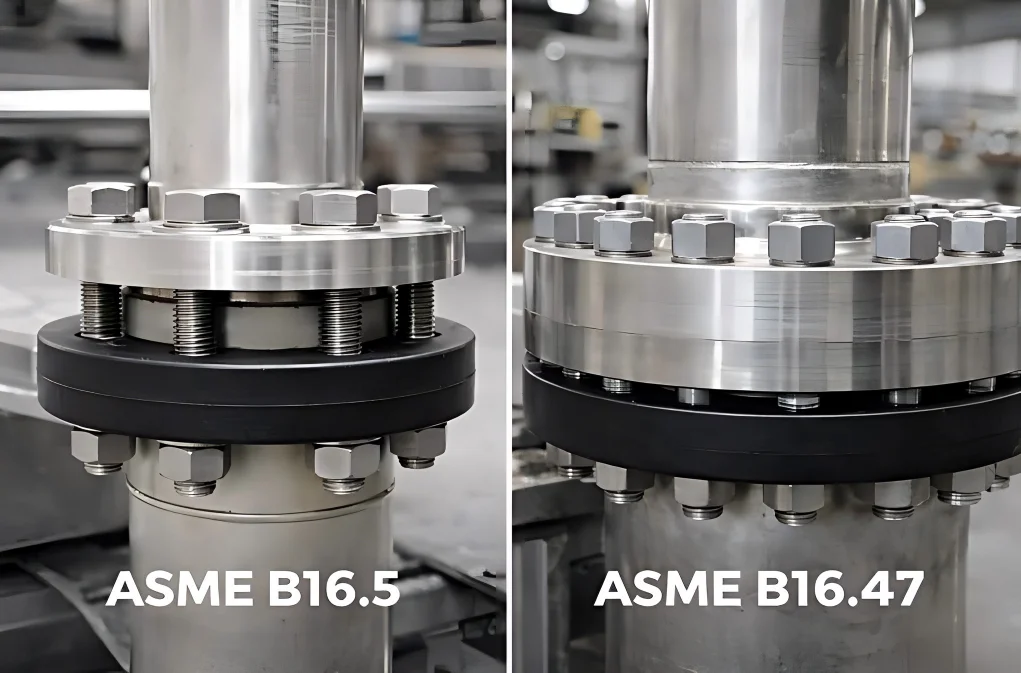
ASME B16.5
ASME B16.5 – Pipe Flanges and Flanged Fittings covers pipe flanges and flanged fittings from NPS 1/2 through NPS 24.
It defines requirements related to:
- Pressure-temperature ratings
- Materials
- Dimensions
- Tolerances
- Flange facings
- Bolt holes
- Marking
- Testing
- Gasket and bolting considerations
- Designation of openings
ASME’s current B16.5 standard includes flange classes 150, 300, 400, 600, 900, 1500, and 2500, with Class 2500 available only for certain sizes.
Typical B16.5 applications
ASME B16.5 flanges are widely used in:
- Oil and gas pipelines
- Refineries
- Petrochemical plants
- Chemical processing
- Power generation
- Water treatment
- Industrial utilities
- Marine systems
- General process piping
ASME B16.47
For large-diameter steel flanges, the applicable standard is generally ASME B16.47.
ASME B16.47 covers NPS 26 through NPS 60 and includes requirements for pressure-temperature ratings, materials, dimensions, tolerances, marking, and testing.
B16.47 includes:
- Series A
- Series B
The two series have different dimensional and bolting configurations.
Therefore, when ordering a large-diameter flange, writing only: “NPS 36, Class 600, WN” is not always sufficient.
The purchase specification should identify the required B16.47 series as well.
Practical rule
| Pipe Size | Typical Governing Standard |
|---|---|
| NPS 1/2–24 | ASME B16.5 |
| NPS 26–60 | ASME B16.47 |
| Large pipeline applications | B16.47 / project specification |
| Specialized pipeline flanges | MSS SP-44 or API/project specification |
| Spectacle blinds, spacers, blinds | ASME B16.48 may apply |
The applicable project specification should always take precedence where it imposes additional requirements.
3. Do Not Treat an ASME Pressure Class as a Fixed Pressure Value
This is one of the most common mistakes in flange selection.
A flange marked:
Class 150
does not simply mean that the flange is rated for 150 psi.
Likewise:
Class 600
does not mean that the flange always has a maximum allowable working pressure of 600 psi.
The allowable pressure depends on factors including:
- Flange material
- Material group
- Operating temperature
- Pressure class
- Applicable standard
- Size
- Service conditions
- Applicable notes and limitations in the standard
ASME B16.5 and B16.47 provide pressure-temperature ratings rather than a single universal pressure value.
Therefore, flange selection should start with:
Design Pressure + Design Temperature + Material
rather than simply selecting a pressure class based on the normal operating pressure.
4. How to Select the Correct ASME Flange Pressure Class
The basic engineering process is:
Step 1 — Determine Design Pressure
Identify the maximum pressure that the piping system is designed to withstand.
Do not use only the normal operating pressure.
Consider:
- Startup conditions
- Shutdown conditions
- Pressure surges
- Pump discharge pressure
- Relief valve settings
- Hydrostatic testing
- Upset conditions
- Transient pressure
- Possible future operating conditions
Step 2 — Determine Design Temperature
Determine the highest and lowest design temperatures.
Temperature has a direct effect on allowable pressure.
As temperature increases, the allowable pressure capacity of many materials decreases.
Low-temperature service also requires careful material selection because some carbon steels can lose toughness at low temperatures.
Step 3 — Identify the Flange Material Group
The selected flange material must correspond to the applicable ASME pressure-temperature table.
Step 4 — Select the Pressure Class
Choose the lowest pressure class that safely satisfies the design pressure and temperature requirements while complying with the applicable standard and project specification.
Example
Suppose a piping system operates at:
- Design pressure: 35 bar
- Design temperature: 200°C
- Material: Carbon steel
The engineer should not automatically specify Class 150.
Instead, the design pressure and temperature should be checked against the applicable ASME pressure-temperature rating table for the selected material group.
5. ASME Flange Pressure Classes
Common ASME flange pressure classes include:
- Class 150
- Class 300
- Class 400
- Class 600
- Class 900
- Class 1500
- Class 2500
For large-diameter B16.47 flanges, the available classes depend on the applicable series and size. The current ASME B16.47 standard includes Class 75, 150, 300, 400, 600 and 900.
General application tendency
| Pressure Class | Typical Service |
| Class 150 | Utilities, water, low-pressure process systems |
| Class 300 | General process and industrial piping |
| Class 600 | Higher-pressure oil, gas and process systems |
| Class 900 | High-pressure process and energy applications |
| Class 1500 | High-pressure critical services |
| Class 2500 | Very high-pressure and specialized services |
These are general application tendencies, not pressure limits.
Final selection must be based on the ASME pressure-temperature rating tables and the actual design conditions.
6. Select the Correct Flange Type
Pressure class alone does not determine the correct flange.
The flange configuration must also match the piping design.
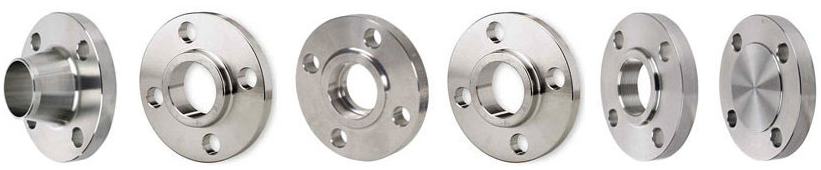
The most common ANSI/ASME flange types include:
- Weld Neck Flange
- Slip-On Flange
- Blind Flange
- Socket Weld Flange
- Threaded Flange
- Lap Joint Flange
- Orifice Flange
- Reducing Flange
- Long Weld Neck Flange
- Custom Engineered Flange
7. Select the Correct Flange Facing
Flange facing is critical because it directly affects gasket seating and sealing performance.
Common flange facings include:
- Raised Face (RF)
- Flat Face (FF)
- Ring Type Joint (RTJ)
- Tongue and Groove
- Male and Female
For many ANSI/ASME industrial applications, RF, FF, and RTJ are the most commonly encountered.
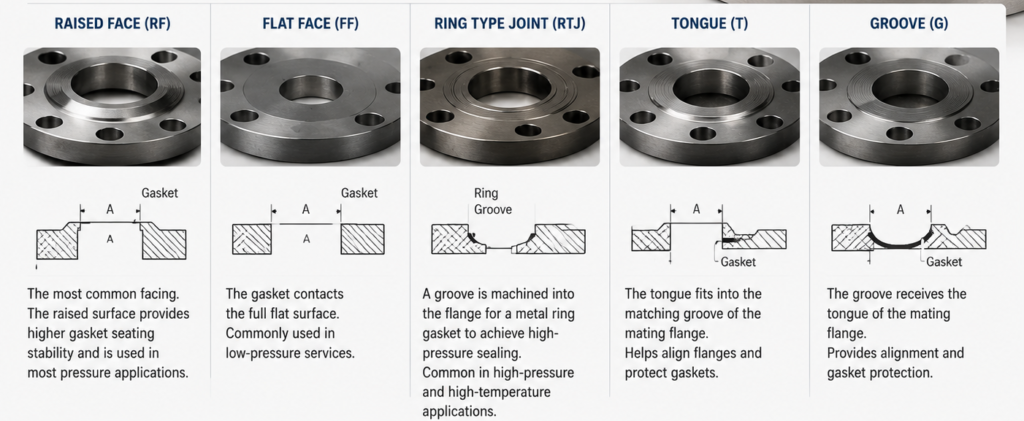
Raised Face (RF)
The raised face flange is one of the most widely used configurations.
The raised sealing surface concentrates gasket seating pressure within the gasket area.
Typical applications include:
- Oil & gas
- Petrochemical
- Chemical processing
- Power generation
- General industrial piping
Flat Face (FF)
A flat face flange has a flat gasket seating surface.
Flat face connections are often used where the mating equipment or flange requires a full-face gasket.
A common example is connecting steel flanges to certain cast iron or other relatively brittle equipment.
The flange facing must always be compatible with the mating component.
8. Flange Facing and Gasket Selection Must Be Considered Together
A flange cannot be selected independently from the gasket.
The sealing system consists of:
Flange Face + Gasket + Bolting + Assembly Procedure
Common gasket categories include:
- Spiral wound gaskets
- Metallic ring gaskets
- Graphite gaskets
- PTFE gaskets
- Compressed fiber gaskets
- Metallic-jacketed gaskets
- Other application-specific sealing materials
When selecting a gasket, consider:
- Process medium
- Operating pressure
- Operating temperature
- Chemical compatibility
- Flange facing
- Bolt load
- Leakage requirements
- Maintenance requirements
For example, an RTJ flange requires the correct RTJ ring gasket rather than a conventional full-face or spiral-wound gasket.
9. Select Flange Material Based on the Actual Service Environment
Material selection is one of the most important parts of flange engineering.
At RAYOUNG, commonly supplied flange materials include:
Carbon Steel
Typical grades include:
- ASTM A105
- ASTM A350 LF2
- ASTM A694
Carbon steel flanges are widely used in:
- Oil pipelines
- Gas transmission
- Water systems
- Steam systems
- Petrochemical service
- General industrial piping
ASTM A105 is a common forged carbon steel flange material for standard-temperature applications.
For low-temperature service, grades such as ASTM A350 LF2 may be considered when required by the design specification.
Stainless Steel Flanges
Common stainless steel grades include:
- ASTM A182 F304
- ASTM A182 F304L
- ASTM A182 F316
- ASTM A182 F316L
- ASTM A182 F321
- ASTM A182 F347
These materials may be selected where corrosion resistance is more important than the lower initial cost of carbon steel.
Typical applications include:
- Chemical processing
- Marine environments
- Water treatment
- Food and pharmaceutical processing
- Corrosive process media
- Offshore applications
Duplex Stainless Steel Flanges
Duplex grades such as:
- F51
- F53
may be selected for demanding environments requiring a combination of:
- High strength
- Chloride resistance
- Stress corrosion cracking resistance
- Improved corrosion performance
Typical applications include:
- Offshore platforms
- Seawater systems
- Desalination
- Marine piping
- Oil & gas production
Alloy Steel Flanges
Common alloy steel grades include:
- ASTM A182 F1
- F5
- F9
- F11
- F22
- F91
These materials are frequently considered for elevated-temperature service, steam systems, and power generation applications.
The material should always be selected according to the complete design envelope rather than temperature alone.
10. Consider Corrosion When Selecting an ANSI/ASME Flange
Pressure and temperature are only part of the selection process.
The process environment may expose the flange to:
- Chlorides
- Hydrogen sulfide
- Carbon dioxide
- Seawater
- Acids
- Alkalis
- Hydrocarbons
- Moisture
- Oxygen
- High-velocity fluids
- Erosive particles
Potential failure mechanisms include:
- General corrosion
- Pitting corrosion
- Crevice corrosion
- Galvanic corrosion
- Stress corrosion cracking
- Erosion-corrosion
- Sulfide-related damage
For corrosive services, the flange material should be evaluated together with the pipe, valve, gasket, bolting, and other wetted components.
11. Check Pipe Size, NPS, DN, Bore, and Wall Thickness
A flange must physically match the pipe and mating equipment.
Important dimensions include:
- Nominal Pipe Size (NPS)
- DN designation
- Outside diameter
- Flange bore
- Inside diameter
- Outside diameter of flange
- Thickness
- Bolt circle diameter
- Number of bolt holes
- Bolt-hole diameter
- Facing dimensions
- Hub dimensions
A common procurement mistake is to specify:
6″ Class 300 WN flange
without providing sufficient information about the pipe wall or bore requirement.
For weld neck flanges in particular, the bore should be compatible with the connected pipe.
12. Why the Flange Bore Matters
The bore affects the transition between the flange and pipe.
If the flange bore is not correctly matched to the pipe:
- Welding may become difficult
- Internal flow can be disturbed
- Stress concentration may increase
- Internal mismatch may occur
- Inspection requirements may not be satisfied
- The component may not match the project drawing
For critical piping systems, the flange bore should be specified according to the applicable pipe outside diameter and wall thickness.
13. Check External Loads on the Flange Connection
Industrial piping may impose loads on flanges from:
- Pipe weight
- Thermal expansion
- Wind
- Seismic loads
- Equipment movement
- Pump vibration
- Compressor vibration
- Pipe support reactions
- Bending moments
- Nozzle loads
This is particularly important for:
- Pump nozzles
- Compressor connections
- Pressure vessel nozzles
- Large-diameter piping
- Offshore piping
- Long elevated pipelines
In these applications, flange selection should be coordinated with the piping stress analysis.
16. How to Select a Flange for Different Industrial Applications
There is no universal “best flange.”
The correct flange depends on the application.
Oil & Gas
Typical priorities:
- Pressure integrity
- Corrosion resistance
- Temperature resistance
- Fatigue performance
- Reliable sealing
- Traceability
Common choices include:
- Weld neck flanges
- Blind flanges
- RTJ flanges
- High-pressure forged flanges
Petrochemical Plants
Key considerations include:
- Hydrocarbon compatibility
- Temperature
- Pressure
- Chemical exposure
- Thermal cycling
- Fire-safe design requirements
Weld neck and RTJ configurations are commonly considered for critical services.
Power Generation
Steam and high-temperature services require careful consideration of:
- Elevated temperature
- Creep resistance
- Thermal cycling
- Alloy selection
- Bolting performance
Alloy steel grades such as F11, F22, or other project-specified materials may be used depending on the system design.
Chemical Processing
The process medium becomes particularly important.
The flange material must be compatible with:
- Acids
- Alkalis
- Solvents
- Chlorides
- Reactive chemicals
Stainless steel, duplex, or specialized alloys may be required.
Water Treatment and Desalination
Water systems can range from relatively mild freshwater service to highly corrosive seawater.
The correct flange material may therefore vary significantly depending on:
- Chloride concentration
- Temperature
- Water chemistry
- Pressure
- External environment
17. Common ANSI/ASME Flange Selection Mistakes
Mistake 1: Treating Class 150 as 150 psi
Pressure class is not simply a fixed pressure number.
Always check the applicable pressure-temperature rating.
Mistake 2: Selecting the flange based only on pipe size
A 4-inch flange can have many different:
- Pressure classes
- Materials
- Face types
- Bore configurations
- Flange types
Pipe size alone is insufficient.
Mistake 3: Ignoring design temperature
A flange that is acceptable at ambient temperature may have a significantly different allowable pressure at elevated temperature.
Mistake 4: Choosing the wrong material
A low-cost carbon steel flange may not be appropriate for:
- Sour service
- Seawater
- Highly corrosive chemicals
- Cryogenic service
- High-temperature applications
Mistake 5: Mismatching the flange faces
RF, FF, and RTJ connections require compatible mating components and sealing arrangements.
Mistake 6: Ignoring the gasket
The flange, gasket, and bolting form one mechanical sealing system.
Mistake 7: Mixing B16.5 and B16.47 dimensions
Large-diameter flanges should be specified according to the correct standard and, where applicable, B16.47 Series A or Series B.
Mistake 8: Assuming a higher class is always better
Overspecifying a flange can increase:
- Purchase cost
- Weight
- Bolt requirements
- Installation effort
- Equipment nozzle loads
- Gasket requirements
The goal is not the highest pressure class.
The goal is the correct pressure class for the design conditions.
18. ANSI/ASME Flange Selection Checklist
Before placing a purchase order, verify the following:
| Parameter | What to Confirm |
| Standard | ASME B16.5, B16.47, MSS SP-44, API 605, etc. |
| Size | NPS / DN |
| Flange Type | WN, SO, BL, SW, TH, LJ, etc. |
| Pressure Class | 150 / 300 / 400 / 600 / 900 / 1500 / 2500 |
| Material | A105, LF2, A182 F304/L, F316/L, etc. |
| Design Pressure | Maximum design pressure |
| Design Temperature | Maximum and minimum |
| Facing | RF / FF / RTJ / other |
| Bore | Pipe OD and wall thickness |
| Bolt Pattern | Number, diameter and bolt circle |
| Gasket | Type and material |
| Bolting | Grade, size and coating |
| Corrosion | Process and environmental conditions |
| Inspection | Required NDT and testing |
| Marking | Standard/project requirements |
| Documentation | MTC, inspection reports, certificates |
| Quantity | Required pieces |
| Delivery | Required delivery date |
This checklist can significantly reduce specification errors during procurement.
19. What Information Should You Send to a Flange Manufacturer?
If you want a manufacturer to quote accurately, provide as much of the following information as possible:
Example RFQ:
Product: Weld Neck Flange
Standard: ASME B16.5
Size: NPS 6
Class: 300
Material: ASTM A105
Facing: RF
Bore: SCH 40
Quantity: 200 PCS
Coating: Black paint / rust preventive oil
Inspection: EN 10204 3.1 MTC
Application: Oil & gas process piping
Required delivery: 30 days
For a large-diameter flange:
Product: Weld Neck Flange
Standard: ASME B16.47
Series: A
Size: NPS 36
Class: 600
Material: ASTM A694 F60
Facing: RTJ
Bore: As per project drawing
Quantity: 40 PCS
The more complete the technical specification, the more accurately a manufacturer can evaluate price, production requirements, tooling, inspection, and delivery.
20. How RAYOUNG Supports ANSI/ASME Flange Procurement
RAYOUNG has specialized in industrial steel pipe fittings, flanges, and steel pipes since 1983.
Our flange product range includes:
- Weld Neck Flanges
- Slip-On Flanges
- Blind Flanges
- Socket Weld Flanges
- Threaded Flanges
- Lap Joint Flanges
- Orifice Flanges
- Ring Flanges
- Custom Engineered Flanges
We supply flanges in:
Carbon Steel
- ASTM A105
- ASTM A350 LF2
- ASTM A694
Stainless Steel
- ASTM A182 F304/F304L
- ASTM A182 F316/F316L
- ASTM A182 F321
- Duplex grades including F51/F53
Alloy Steel
- ASTM A182 F1
- F5
- F9
- F11
- F22
- F91
Our standard and customized flange solutions cover a broad range of industrial requirements, including ASME B16.5 and ASME B16.47 Series A/B, as well as other project-specific standards.
RAYOUNG’s manufacturing and quality-control capabilities include forging, machining, heat treatment, dimensional inspection, material inspection, ultrasonic testing, magnetic particle testing, X-ray inspection and hydrostatic testing according to applicable requirements.
Our production information indicates more than 35,000 m² of factory area, approximately 700 tons/month of flange output, and annual production capacity of up to 30,000 tons across our product range.
Email: info@hb-steel.com
WhatsApp: +86 180 0311 9682
Website: https://hb-steel.com/
Frequently Asked Questions About ANSI/ASME Flange Selection
What is the difference between ANSI and ASME flanges?
In modern industrial specifications, the term “ANSI flange” is commonly used to refer to flanges manufactured according to ASME dimensional and rating standards such as ASME B16.5. When preparing a technical specification, it is better to identify the exact ASME standard rather than simply writing “ANSI flange.”
What standard covers ANSI/ASME flanges?
ASME B16.5 covers pipe flanges and flanged fittings from NPS 1/2 through NPS 24. ASME B16.47 covers large-diameter steel flanges from NPS 26 through NPS 60.
What are the common ASME flange pressure classes?
Common classes include 150, 300, 400, 600, 900, 1500 and 2500. The available class depends on the standard and flange size.
Does Class 300 mean 300 psi?
No. ASME pressure classes are not simple fixed pressure values. Allowable pressure depends on material and temperature and must be determined using the applicable ASME pressure-temperature ratings.
What is the difference between RF and RTJ flanges?
RF means Raised Face and is widely used with conventional gasket systems. RTJ means Ring Type Joint and uses a metallic ring gasket seated in a precision-machined groove. RTJ connections are commonly selected for demanding high-pressure and high-temperature applications.
Which is better: weld neck or slip-on flange?
Neither is universally better. Weld neck flanges are generally preferred for more demanding pressure, temperature, fatigue, and cyclic applications, while slip-on flanges can be an economical solution for less severe services.
What material is commonly used for carbon steel flanges?
ASTM A105 is one of the most common forged carbon steel flange materials. Other grades such as ASTM A350 LF2 or ASTM A694 may be selected when low-temperature or high-strength requirements apply.
How do I select a flange manufacturer?
Check whether the manufacturer can provide:
- Applicable ASME standards
- Material traceability
- MTCs
- Dimensional inspection
- NDT
- Heat treatment records where applicable
- Third-party inspection
- Consistent production capability
- Export experience
- Technical support