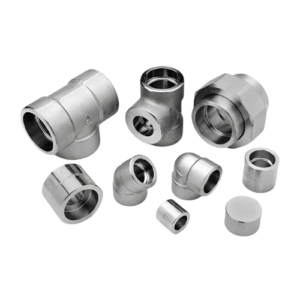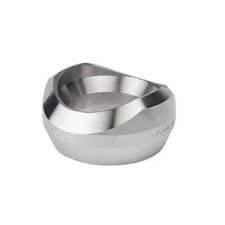

What is Forged Pipe Fitting?
A forged pipe fitting is a high-pressure piping component manufactured through a forging process, which involves heating carbon, stainless, or alloy steel and shaping it using mechanical forces. Unlike cast fittings, the forging process eliminates internal porosity and refines the grain structure, providing exceptional mechanical strength, higher fatigue resistance, and superior pressure-bearing capacity. Forged fittings are primarily connected via Socket Weld (SW) or Threaded (NPT/BSPT) ends and are universally governed by the ASME B16.11 standard for critical, high-pressure industrial environments.
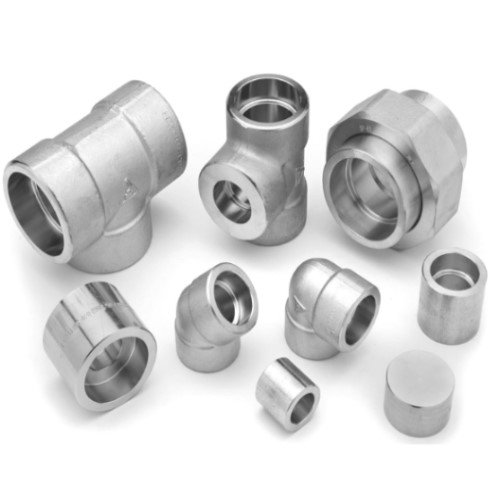
Technical Specifications for Forged Pipe Fittings
| Parameter | Industry Specifications & Standards |
|---|---|
| Manufacturing Standards | ASME B16.11 (Core Standard), MSS SP-79, MSS SP-83, MSS SP-95, BS 3799 |
| Connection Types | Socket Weld (SW) and Threaded / Screwed (NPT, BSPT, BSPP conforming to ASME B1.20.1) |
| Pressure Ratings / Classes | Threaded Fittings: 2000 LBS, 3000 LBS, 6000 LBS Socket Weld Fittings: 3000 LBS, 6000 LBS, 9000 LBS |
| Available Product Types | 45°/90° Forged Elbows, Street Elbows, Equal/Reducing Tees, Crosses, Full/Half Couplings, Reducing Couplings, Pipe Caps, Hex/Square/Round Plugs, Hex Bushings, Flush Bushings, Hex Nipples, Unions (MSS SP-83) |
| Branch Outlet Fittings (Branchlets) | Weldolet, Threadolet, Sockolet, Elbolet, Latrolet, Nipolet (Conforming to MSS SP-97) |
| Size Range Capacity | 1/8″ to 4″ (DN6 – DN100) Nominal Pipe Size |
| Carbon Steel Forged Grades | ASTM A105 (Most Common), ASTM A350 LF2 (Low Temp), ASTM A694 F42/F52/F60/F65 (High Yield) |
| Stainless Steel Forged Grades | ASTM A182 F304/304L, ASTM A182 F316/316L, F321, F347, F51 (Duplex), F53 (Super Duplex) |
| Alloy Steel Forged Grades | ASTM A182 F11, F22, F5, F9, F91 (High-Temperature Chrome-Moly) |
Frequently Asked Questions About Forged Pipe Fittings
Q: What is the difference between Socket Weld (SW) and Threaded forged fittings?
- A: The primary difference lies in the sealing mechanism and application safety. Socket Weld fittings require a fillet weld to connect to the pipe, offering a permanent, leak-proof, and stronger joint ideal for toxic, flammable, or high-pressure systems. Threaded fittings rely on complementary pipe threads (like NPT) for connection, allowing for easy disassembly, non-welded installation, but are more prone to dynamic load leaks and restricted in critical hazardous services.
Q: What does “3000 LBS” or “3000#” mean in forged fittings?
- A: 3000 LBS (or Class 3000) represents the pressure rating class of the forged fitting, not its maximum working pressure in PSI. It indicates the fitting is structurally matched to perform safely with specific high-pressure pipe schedules (e.g., Class 3000 Socket Weld fittings match with Schedule 80 / XS pipes, while Class 6000 matches with Schedule 160 pipes).
Q: What are Branch Outlets (Olets) and when are they used?
- A: Branch Outlets (such as Weldolets, Threadolets, and Sockolets) are forged integrally reinforced fittings used to provide a 90-degree branch connection from a larger run pipe to a smaller branch pipe. They are utilized as an alternative to reducing tees when the run pipe is significantly larger than the branch, saving space, welding time, and reducing stress concentration.
Q: How do you inspect the quality of ASME B16.11 forged fittings before shipment?
- A: Premium forged fittings must pass a strict four-point quality assurance protocol before leaving the factory:
- Thread & Socket Gauging: Threaded fittings must be verified using precise Go/No-Go plug gauges to ensure NPT/BSPT compliance. Socket depths and diameters must meet ASME B16.11 tolerances.
- Hardness Testing: Conducted particularly on alloy steel (e.g., F11, F22) and stainless steel batches to verify heat treatment effectiveness.
- Positive Material Identification (PMI): Utilizing handheld X-ray fluorescence (XRF) alloy analyzers to verify exact chemical compositions (Cr, Ni, Mo content) for stainless and alloy grades.
- Visual and Geometric Check: Inspecting for forging folds, scale, sharp burrs, and ensuring proper rust-proof oil coating or hot-dip galvanizing.
Q: Where are forged steel pipe fittings typically applied?
- A: Due to their high mechanical strength, forged fittings are mandatory in high-stress, high-pressure, and hazardous piping systems, including:
- Hydraulic & Pneumatic Systems: High-pressure fluid power lines and control loops.
- Chemical & Petrochemical Industry: Transporting highly corrosive, acidic, or volatile process chemicals.
- Oil & Gas Sector: High-pressure gas gathering lines, refinery manifolds, and offshore drilling platforms.
- Steam & Power Plants: Superheated steam distribution lines, boiler piping, and high-pressure feed water networks.
Why Choose RAYOUNG/JS FITTINGS for Your Forged Pipe Fittings?
- Compliant with EN 10204 3.1 & Full Traceability: We provides 100% original Mill Test Certificates (MTC) mapping back to the steel mill’s heat numbers, guaranteeing absolute chemical and mechanical compliance.
- Precision Threading Equipment: Our CNC machining lines utilize advanced thread-cutting tools to ensure zero-defect NPT, BSPT, or BSPP connections, eliminating on-site installation alignment issues.
- Extensive Stock for Quick Turnaround: We carry a comprehensive ready-to-ship stock of Class 3000 ASTM A105 and A182 F316L standard elbows, tees, and unions, compressing shipping preparation to 7-14 days.
- Anti-Corrosion Surface Excellence: All carbon steel forged fittings undergo premium surface passivation, including deep black phosphating, rust-preventative oiling, or Hot-Dip Galvanizing (HDG) to prolong service life in coastal or high-humidity environments.
Please contact us if you have any questions or inquirements for buttweld pipe fittings.inquiries