

In any industrial piping system, the connection is the most frequent point of failure. Choosing the right flange is about more than just matching sizes; it’s about ensuring a leak-proof seal under pressure.
At RAYOUNG, we specialize in manufacturing high-performance flanges that meet rigorous global standards. One of the most common questions our engineering team receives is: “Should I use a Raised Face (RF) or a Flat Face (FF) flange?”
This guide breaks down the technical differences to help you make an informed procurement decision.
1. What is a Raised Face (RF) Flange?
The Raised Face Flange is the industry standard for high-pressure applications. You can identify it by the small, elevated section surrounding the bore, located inside the bolt holes.
How it Works:
The design “concentrates” the bolt load onto a smaller surface area (the raised face). This creates a high-pressure seal against the gasket, allowing the joint to withstand significantly more internal stress than a flat connection.
Key Advantages of Raised Face Flanges:
- Pressure Resistance: Ideal for ASME Class 150 up to Class 2500.
- Serrated Finish: RAYOUNG RF flanges feature precision-machined serrations (concentric or spiral) that “bite” into the gasket to prevent blowouts.
- Application: Dominant in Oil & Gas, Petrochemical, and Power Generation where safety is non-negotiable.
The most common types of raised face pipe flanges include blind, slip-on, and socket weld flanges.
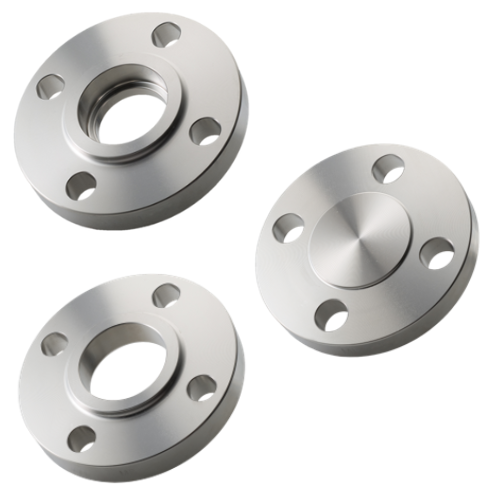
2. What is a Flat Face (FF) Flange?
Unlike the RF type, Flat Face Flanges have a completely level surface with no protrusion. The gasket makes contact across the entire face, from the inner diameter to the outer edge.
Why Use Flat Face?
The primary goal of an FF flange is to prevent bending stress. When you bolt two flanges together, the force can cause the flange “wings” to bend. While steel is resilient, other materials are not.
Best Use Cases:
- Low-Pressure Systems: Common in water treatment, HVAC, and low-temp plumbing.
- Fragile Connections: FF flanges are mandatory when connecting to cast iron pumps, valves, or equipment. Using an RF flange on cast iron can cause the equipment to crack under the bolt torque.
The most common types of flat face pipe flanges include blind, lap joint, slip-on, and weld neck flanges.
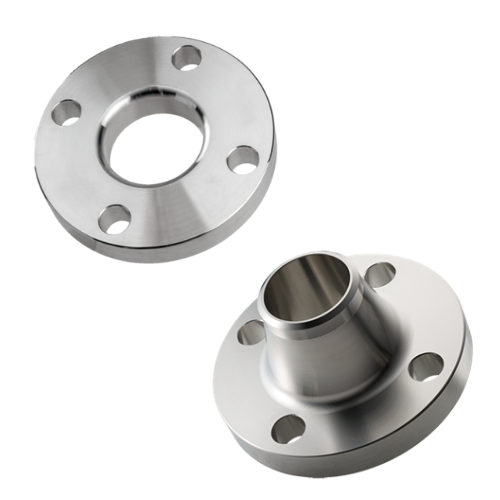
RF vs. FF flanges: A Quick Comparison Table
| Feature | Raised Face (RF) flanges | Flat Face (FF) flanges |
| Pressure Rating | High (Class 150 – 2500) | Low (Class 125 – 150) |
| Gasket Type | Ring Gasket | Full-Face Gasket |
| Main Benefit | Superior Sealing Power | Prevents Material Cracking |
| Industry | Oil, Gas, Chemical | Water, Pump Stations |
Selection Criteria: What Should You Consider?
Before placing your order with RAYOUNG, verify these four factors with your engineering team:
- Operating Pressure & Temperature: High-heat and high-pressure environments almost always require Raised Face Flanges.
- Mating Material: Ensure you aren’t bolting a steel RF flange to a cast iron FF component.
- Media Type: For volatile or hazardous fluids, the concentrated seal of an RF flange offers better safety.
- Gasket Choice: RF flanges typically use metallic or semi-metallic gaskets (like spiral wound), while FF flanges use soft, non-metallic materials.
Why Source Your Flanges from RAYOUNG?
As a leading export-oriented factory, RAYOUNG (HB Steel) understands that a single faulty flange can shut down an entire production line. We provide:
- Precision Machining: CNC-finished surfaces for perfect gasket seating.
- Material Integrity: Full traceability and MTR (Mill Test Reports) for every batch.
- Global Compliance: Flanges manufactured to ASME, DIN, EN, and JIS standards.
Get a Technical Quote Today
Need help specifying the right flange for your next project? Our team is ready to assist with technical drawings and competitive pricing.
- Email: info@hb-steel.com
- Phone/WhatsApp: +86-18003119682
- Website: https://hb-steel.com/