

In the world of industrial piping, the slip-on flange (SO flange) remains one of the most widely utilized components due to its versatility and ease of installation. Designed to “slip over” the end of a pipe, these flanges are preferred in low-pressure and low-risk applications.
However, for a procurement manager or a stockist, selecting the right ASME B16.5 Carbon Steel slip-on flange involves more than just picking a size. It requires a deep understanding of hub designs, facing types, and welding protocols. This guide provides the technical clarity needed to make informed sourcing decisions.
1. What is a Slip-On Flange with Hub?
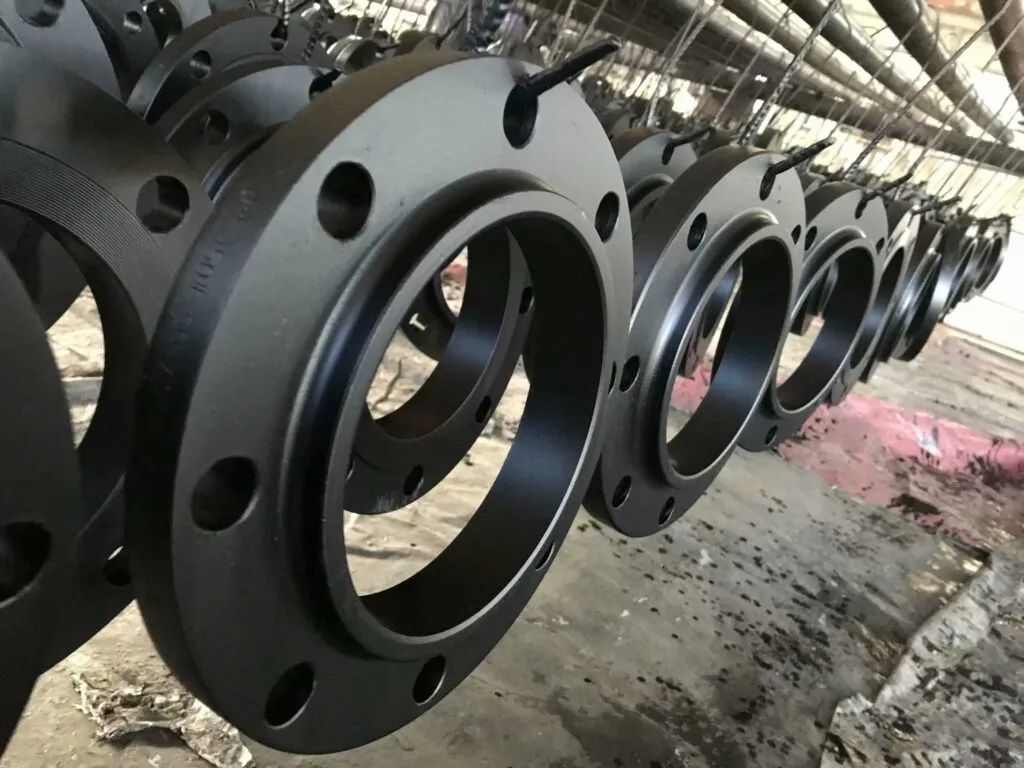
Technically, a slip-on flange consists of a flat plate with a central bore that is slightly larger than the outside diameter (OD) of the pipe. Most industrial-grade slip-on flanges are manufactured as a slip-on flange with hub, which provides extra reinforcement and helps distribute the stress at the base of the flange.
The internal diameter of the flange is precisely engineered to ensure the pipe can slide through easily before being secured via fillet welds at both the top and bottom (inside and outside) of the flange.
2. ASME B16.5 Standards and Materials
When sourcing for international projects, compliance with the slip-on flange standard is non-negotiable. The most common standard is ASME B16.5, which covers pipe flanges and flanged fittings from NPS 1/2 through NPS 24.
- Common Materials: For most industrial applications, the ASME B16.5 Carbon Steel slip on flange (specifically ASTM A105) is the industry standard due to its durability and cost-effectiveness.
- Pressure Ratings: Available in Classes 150, 300, 600, 900, and 1500 (though SO flanges are rarely used above Class 600 due to structural limitations).
ASME B16.5 Slip-On Flange Dimensional Comparison: Class 150 vs. Class 300
For professional stockists and engineers, understanding the dimensional variance between pressure classes is essential for ensuring pipeline compatibility. Below is a quick-reference table for common ASME B16.5 Carbon Steel Slip-on Flange sizes.
| Nominal Pipe Size (NPS) | Pressure Class | Outside Diameter (OD) | Number of Bolt Holes | Bolt Circle Diameter | Bolt Hole Diameter |
| 2″ (DN50) | Class 150 | 6.00″ (152.4 mm) | 4 | 4.75″ | 0.75″ |
| 2″ (DN50) | Class 300 | 6.50″ (165.1 mm) | 8 | 5.00″ | 0.75″ |
| 4″ (DN100) | Class 150 | 9.00″ (228.6 mm) | 8 | 7.50″ | 0.75″ |
| 4″ (DN100) | Class 300 | 10.00″ (254.0 mm) | 8 | 7.88″ | 0.88″ |
| 6″ (DN150) | Class 150 | 11.00″ (279.4 mm) | 8 | 9.50″ | 0.88″ |
| 6″ (DN150) | Class 300 | 12.50″ (317.5 mm) | 12 | 10.62″ | 0.88″ |
3. Understanding Facing: Slip-On Flange Raised Face (RF)
One common point of confusion in procurement is the difference between slip on flange vs raised face. To clarify: “Slip-on” refers to the type of flange, while “Raised Face” refers to the facing of the flange.
A slip-on flange raised face (RF) features a small portion around the bore that is elevated above the bolting circle. This design concentrates pressure on a smaller gasket area, ensuring a superior leak-proof seal.
- Slip-on raised face flange dimensions vary by pressure class; for instance, a Class 150 flange typically has a 1/16″ raised face, whereas Class 600 and above have a 1/4″ raised face.
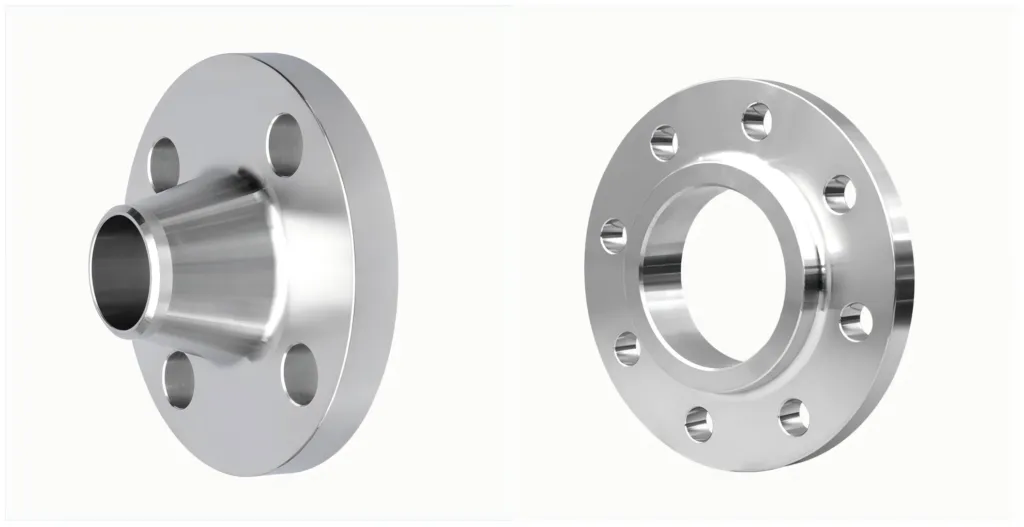
4. Slip-On Flange vs. Weld Neck: Which One to Choose?
This is the most frequent technical comparison in the industry. Here is the breakdown:
- Installation Cost: Slip-on flanges have a lower initial cost and are easier to align. However, they require two fillet welds.
- Strength: A Weld Neck (WN) flange is structurally stronger and handles vibration and high-pressure cycles better because of its tapered hub.
- Application: Slip-on flange use is ideal for low-pressure cooling water, fire water, and low-pressure compressed air lines. Weld neck flanges are reserved for critical, high-pressure steam or hazardous chemical lines.
5. Slip-On Flange Welding and Installation
The integrity of a slip-on connection depends entirely on the slip on flange welding quality. Unlike weld neck flanges that use a butt weld, slip-on flanges require:
- An Internal Fillet Weld: To seal the end of the pipe inside the flange.
- An External Fillet Weld: To provide structural strength to the hub.
Technical Note: During installation, the pipe end is typically set back from the flange face by a distance equal to the pipe wall thickness plus 3mm to prevent damage to the flange face during welding.
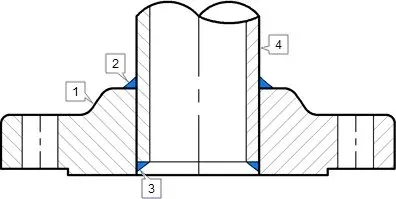
- slip-on flange 2. outside fillet welds 3. inside fillet welds 4. pipe
6. Navigating Slip-On Flange Dimensions for Procurement
For stockists, maintaining an accurate inventory requires a precise slip-on flange dimensions chart. Key measurements include:
- Outside Diameter (OD)
- Bolt Circle Diameter
- Bore Diameter (Must be slightly larger than the pipe’s OD)
- Hub Height
At RAYOUNG, we provide full dimensional transparency, ensuring that every flange meets the tight tolerances required by ASME B16.5.
Partnering with a Reliable Slip-On Flange Supplier
Choosing the right slip on flange supplier is about more than just finding the lowest price—it’s about ensuring material traceability, dimensional accuracy, and consistent quality.
Whether you are looking for ASME B16.5 Carbon Steel slip on flanges for a new construction project or looking to replenish your inventory as a distributor, HB Steel offers a comprehensive range of sizes and pressure classes.
Ready to source high-quality flanges?
View our Slip-On Flange Technical Specifications and Get a Quote