

If you’ve ever had a shipment of “ASTM A105 forged flanges” fail incoming inspection, you know why this article exists. On paper, two flanges look identical. In service, one holds pressure for twenty years and the other cracks at the weld. The difference usually comes down to a handful of things a supplier either tells you upfront or quietly leaves out.
Here’s what to check.
Is It Really a Forged Flange?
Not every steel flange is made by forging, and that is not necessarily a problem. Plate flanges, forged flanges and other machined flange products serve different applications. What matters is whether the manufacturing route matches the product specification and what the supplier has quoted.
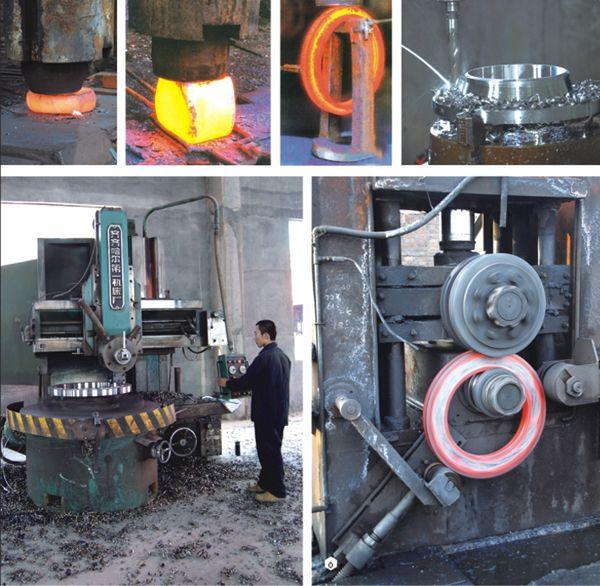
If your purchase order requires an ASTM A105 forged flange, ask the supplier to confirm the starting material, forging method, heat treatment condition and traceability records. Depending on the product design, manufacturing may involve open-die forging, upset forging or ring rolling, followed by machining and inspection.
A plate flange manufactured from plate should be identified and supplied as such, not presented as a forged product. For buyers, the important checks are the material specification, manufacturing route, applicable product standard and inspection records — not just the appearance of the finished flange.
ASTM A105 and A105N: What Should Buyers Specify?
ASTM A105 is a widely used carbon steel forging specification for pipeline flanges and other pressure-containing components. However, specifying A105 alone does not always tell the buyer the complete heat treatment requirement.
A105N is commonly used in commercial descriptions to identify ASTM A105 forgings supplied in the normalized condition. Normalizing can affect the material’s mechanical properties and microstructure, so buyers should confirm the required heat treatment condition in the purchase order and verify it against the MTC.
A105 VS A105N, please click here.
Do not rely on the suffix alone. Check the material specification, heat treatment record, chemical composition and mechanical test results to ensure that the supplied flange meets the project requirements.
Standards and faces cause more trouble than people expect
A raised face (RF), flat face (FF) and ring type joint (RTJ) are different sealing arrangements and must be selected according to the mating flange, gasket and service conditions.
Before ordering, confirm the facing type on both connecting flanges, the gasket arrangement and the applicable dimensional standard. RF and FF connections should not be treated as automatically interchangeable, while RTJ flanges require a matching ring-joint groove and metal ring gasket.
For lap joint flanges, also specify the stub end separately. Its material, wall thickness and compatibility with the process fluid must be checked independently of the backing flange.
Material Selection for Corrosive Service
For chemical processing, offshore pipelines and other corrosive environments, ASTM A105 carbon steel may not be suitable for every application. Depending on the fluid composition, operating temperature and design conditions, the project may require stainless steel grades such as 304/304L or 316/316L, duplex stainless steel such as 2205, or another specified alloy.
A protective coating may help in certain external environments, but it does not automatically make carbon steel suitable for internal exposure to corrosive process fluids.
Buyers should provide the operating medium, concentration, temperature and relevant corrosion requirements before requesting a material recommendation. The final selection should follow the project specification and be confirmed by the responsible materials or piping engineer.
Blind Flanges: A Small Item with a Critical Pressure-Boundary Role
A blanking flange is the simplest thing in the catalog — a solid disc with bolt holes — which is exactly why it gets specified carelessly. Blanks see full line pressure with no pipe support, so thickness and grade matter. On a high-pressure or high-temperature line, the blank is not the place to save money.
For OEMs and distributors, supply reliability is part of the product
If you’re sourcing forged flanges for industrial OEM distribution or a power industry project, the spec is only half the job. Can the supplier hold your schedule? Do they stock common sizes, or is everything made to order on a 60-day lead time? Can they go from a sample to a full container without the quality drifting?
A forged flange supplier worth working with will tell you honestly what they can and can’t do. Ask about MOQ, lead times for stock and custom sizes, and whether they’ve shipped into your industry before. Power generation and petrochemical work carry their own approval paperwork — a supplier who’s done it before saves you months.
Inspection isn’t optional
Ask what testing comes as standard: visual and dimensional checks, NDT (ultrasonic or magnetic particle) on the forging, hydrostatic tests where applicable. For critical service, third-party inspection (SGS, BV, Lloyd’s) is cheap insurance. The required inspection method and acceptance criteria should be specified in the purchase order or project inspection and test plan (ITP), rather than assuming that every flange requires the same NDT scope.
Get the scope in the contract. “Inspected” means nothing until you know who inspected, to which standard, and whether you actually get the report.
Before you place the order — a short checklist
- Forged, not cast or plate-cut, with the process confirmed in writing
- Grade and heat treatment stated — A105 vs A105N, not just “A105”
- MTC / EN 10204 3.1 matching the heat number on the flange
- Standard, size, class, face type and bolt pattern confirmed on the drawing
- Material matched to the service, especially for corrosive or hot lines
- Honest lead time and MOQ for both stock and custom sizes
- Inspection scope and test reports agreed upfront
How Forged Flanges Are Manufactured
- Raw material inspection and heat identification.
- Billet heating and forging.
- Heat treatment according to the material specification and order.
- CNC machining and flange facing.
- Dimensional and mechanical inspection.
- Marking, MTC verification and export packaging.
Where flanges actually fail
A forged flange is a small part with a big job. The ones that fail in the field almost always failed at the purchasing stage — wrong material, unverified forging, a missed face type, a supplier who couldn’t back up their claims. None of that shows up on a quote comparison.
Buy from a forged flange manufacturer who answers the awkward questions before you have to ask. That’s the whole difference.
Source Forged Steel Flanges for Your Next Project
Looking for a reliable forged flange manufacturer for your distribution business or industrial project?
RAYOUNG supplies carbon steel, stainless steel and alloy steel flanges in various types, sizes, pressure classes and international standards.
Send us your flange list or drawings, including the standard, size, pressure class, material, facing type and quantity. Our team will review the specifications and provide a quotation based on your project requirements.
Contact RAYOUNG for a forged flange quotation.