

Elbows are fundamental components in piping systems, designed to redirect flow while maintaining system integrity and efficiency. Choosing the right elbow type is crucial to optimizing performance based on space, pressure, and maintenance needs. This guide explains the differences, applications, and key advantages of long radius and short radius elbows, empowering engineers and buyers with nuanced insights.
Elbows are categorized based on their curvature radius, distinguishing between long radius elbows and short radius elbows. A long radius elbow has a curvature radius equivalent to 1.5 times the outer diameter of the pipe, denoted as R=1.5D. Conversely, a short radius elbow features a curvature radius equal to the outer diameter of the pipe, expressed as R=D. Here, D represents the diameter of the elbow, and R denotes the curvature radius.
What Is an Elbow Radius?
The elbow radius refers to the curvature length between the inlet and outlet of an elbow fitting. This design factor determines flow patterns, pressure losses, and the physical space required for installation. Elbows are classified by the ratio of their curvature radius (R) to the pipe diameter (D):
Long Radius (LR) Elbow: Curvature radius is 1.5 times the nominal diameter (R = 1.5D).
Short Radius (SR) Elbow: Curvature radius equals the nominal diameter (R = 1D).
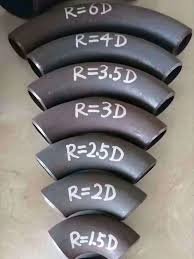
Long Radius Elbow (LR Elbow): Features and Benefits
A long radius elbow features a more gradual curve, providing smoother fluid flow with less resistance and minimal turbulence. This configuration is highly suitable for high-flow and high-pressure applications where efficiency matters.
Key Advantages
- Reduced Pressure Drop: The gentle bend offers less resistance, maintaining system efficiency.
- Improved Flow Efficiency: Supports high-speed flows and protects sensitive processes.
- Lower Turbulence and Wear: The even curve reduces internal wear and erosion in the piping system.
- Enhanced Versatility: Can be installed in both low and high-pressure pipelines.
Common Applications
- Oil and gas pipelines
- Power generation plants
- Chemical processing facilities
- HVAC systems
- Pneumatic conveying where smooth flow is paramount.
Short Radius Elbow (SR Elbow): Features and Benefits
Short radius elbows have a tighter bend, making their overall footprint more compact. Although they create higher turbulence and pressure drops, their small size suits installations where space and budget constraints are dominant.
Key Advantages
- Space Efficiency: Ideal for crowded layouts and confined mechanical rooms.
- Cost-Effectiveness: Uses less material, typically priced lower than LR elbows.
- Sharper Direction Change: Suitable for specific mechanical designs and retrofits.
Common Applications
- Marine piping systems
- Plumbing in restricted areas
- Compact industrial setups
- Skid-mounted and HVAC systems.
Comparative Performance:
- Effects of fluid flow:
Long radius elbow: Due to the larger bending radius, the fluid flows more gently in the elbow and the flow resistance is relatively small. This makes long-radius elbows more suitable in some applications that require smooth fluid flow.
Short Radius Elbow: The bend is sharper and the fluid will experience greater resistance within the elbow, so short radius elbows may result in some energy loss and flow turbulence.
- Wear and Durability
LR elbows display reduced wear and corrosion due to minimized flow resistance, resulting in longer service life and lower maintenance costs. - System Maintenance
Long radius elbows enable better access for cleaning and inspection. SR elbows may limit maintenance in tight locations, potentially raising downtime and costs.
How to Choose the Right Elbow for your projects?
Core Considerations
Space Availability: SR elbows for tight spaces; LR elbows for unobstructed layouts.
Flow Efficiency Needs: LR elbows for critical systems requiring smooth, efficient flow.
Budget Constraints: SR elbows may be preferred for cost savings.
System Pressure: LR elbows for high-pressure and velocity; SR elbows for low-pressure fluids.
Advanced Selection Criteria
Degree of Bend: Common options are 45°, 90°, and 180°, with custom angles for unique installations.
Material Compatibility: Match the elbow material to the transported media for chemical resistance and performance.
Standard Compliance: Ensure elbows meet global codes like ASME, DIN, or ISO.
Application-Specific Strategies
Energy Pipeline Systems
Long radius elbows minimize energy loss, reduce maintenance, and extend pipeline life in energy and petrochemical sectors.
Industrial Skids and HVAC
Short radius elbows fit compact machines and crowded utility rooms, balancing space with functional efficiency.
Pneumatic Conveying Systems
Wear protection is critical in pneumatic transport. LR elbows offer gentler curves for reduced degradation in bulk solids; SR elbows may suit special handling requirements like sticky or delicate materials.
Conclusion
Understanding the crucial differences between long radius and short radius elbows makes a significant impact on piping system performance, durability, and cost-effectiveness. Whether prioritizing smooth flow and low maintenance or addressing tight installation needs and budget constraints, the right elbow selection optimizes operations across industries.
Rayoung delivers expertise and flexibility in supplying elbows tailored to every project specification, ensuring peak system reliability and long-term value.
IF YOU HAVE ANY INQUIRY, PLEASE DON’T HESITATE TO CONTACT US IMMEDIATELY
Email: info@hb-steel.om
Tel/WhatsApp: +86-18003119682
