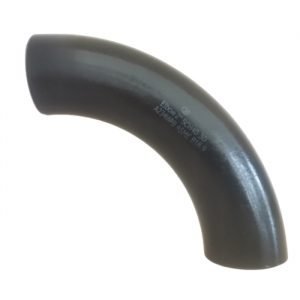

If you are sourcing carbon steel ASME B16.49 bends, comparing suppliers, or preparing a purchase specification for a pipeline project, for pipeline projects, the bend radius, pipe size, wall thickness, material grade, tangent length, manufacturing process, inspection, and documentation all affect whether the finished product meets specifications.
This guide focuses on the information that actually matters when sourcing ASME B16.49 induction bends for industrial and pipeline applications. It explains what ASME B16.49 covers, how induction bends are manufactured, which specifications buyers should confirm, why bend radius matters, and what information should be included in an RFQ.
What Is an ASME B16.49 Bend?
ASME B16.49 is the standard for factory-made, wrought steel, buttwelding induction bends for transportation and distribution systems.
Unlike a conventional ASME B16.9 elbow, an ASME B16.49 bend is produced by locally heating the pipe through an induction coil and forming the required radius and angle. The process allows manufacturers to produce large-diameter and long-radius bends for pipeline applications.
The current edition is ASME B16.49-2023. The standard covers requirements related to design, materials, manufacturing, testing, marking, and inspection. It is intended for pipeline applications such as those covered by ASME B31.4 and ASME B31.8.
This makes an ASME B16.49 induction bend particularly relevant to:
- Oil and gas transmission pipelines
- Natural gas pipelines
- Petroleum transportation systems
- Long-distance water pipelines
- Slurry and industrial transmission lines
- Other transportation and distribution piping systems
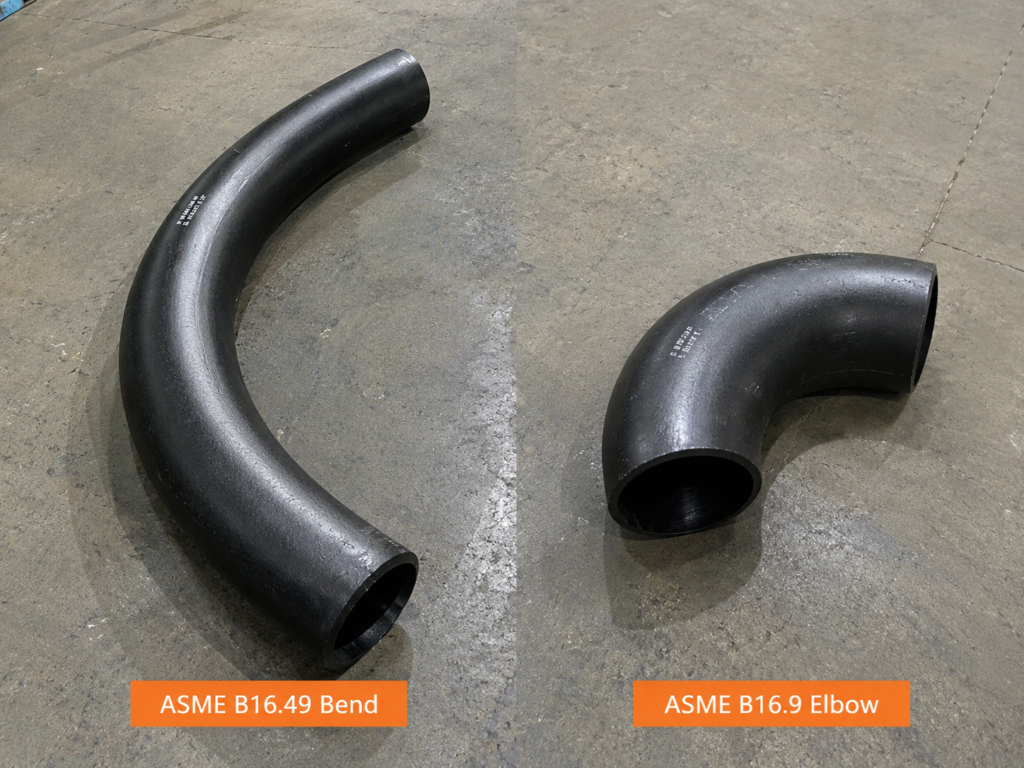
ASME B16.49 Bend vs. ASME B16.9 Elbow
The two products are sometimes mixed together in purchasing inquiries, but they are not the same product.
ASME B16.9 elbows are standardized butt-welding fittings commonly supplied in configurations such as 45° and 90° long-radius elbows.
ASME B16.49 bends are induction-bent pipeline components designed around the requirements of the pipeline system. They are commonly specified by bend radius, angle, wall thickness, tangent length, pipe grade, and manufacturing requirements.
For a long-distance pipeline, the larger radius of a bend can provide a smoother change in flow direction and can also be advantageous where pipeline pigging and inspection are required.
If the project specification specifically calls for an ASME B16.49 induction bend, replacing it with an ordinary B16.9 elbow should not be treated as an equivalent substitution without engineering approval.
Key Specifications for ASME B16.49 Bends
A professional RFQ should provide enough information for the manufacturer to calculate the correct production requirements.
Typical ordering information includes:
| Item | Typical Requirement |
|---|---|
| Standard | ASME B16.49 |
| Pipe Size | NPS / DN |
| Outside Diameter | Project requirement |
| Wall Thickness | mm / Schedule |
| Bend Radius | 3D, 5D, 6D, 8D or specified radius |
| Bend Angle | 15°, 30°, 45°, 60°, 90° or custom |
| Material | Carbon steel / specified line pipe grade |
| Pipe Type | Seamless or welded |
| Tangent Length | As required |
| End Preparation | Butt-welding / project requirement |
| Inspection | Standard or supplementary requirements |
| Coating | If required by the pipeline project |
The purchaser should confirm these details before placing an order because changing the radius, wall thickness, material grade, or tangent length can affect both production and final dimensions.
How Are ASME B16.49 Induction Bends Manufactured?
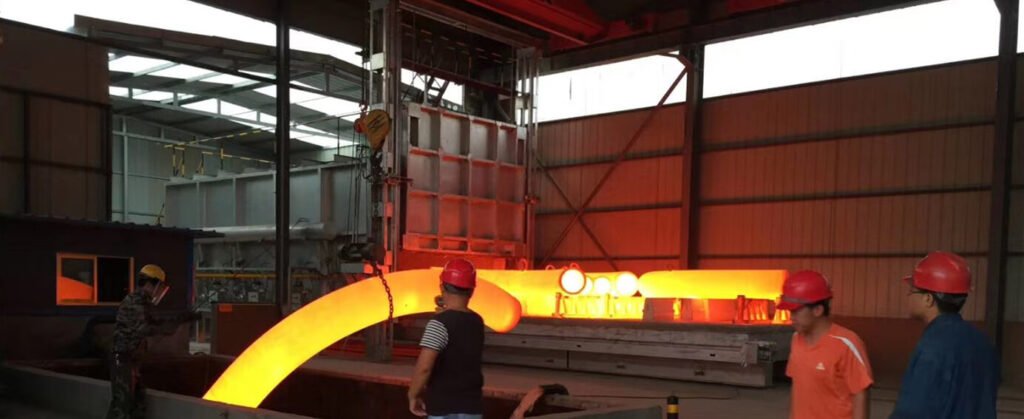
The defining manufacturing method is induction bending.
During production, a narrow circumferential section of the pipe is heated by an induction coil while the pipe is pushed through the bending machine at a controlled rate. The heated section becomes sufficiently ductile to form the required bend radius while the remaining pipe maintains its structural shape.
After bending, the manufacturer may carry out controlled cooling, dimensional inspection, end preparation, marking, and the required testing.
For pipeline buyers, the important point is that the manufacturing process must be controlled carefully. Excessive deformation, dimensional deviation, or inappropriate heat treatment can affect wall thickness, mechanical properties, and the final fit-up during field welding.
What Materials Are Used for ASME B16.49 Bends?
ASME B16.49 focuses on carbon steel pipeline bends with controlled chemistry and mechanical properties. The actual material grade should be selected according to the pipeline design and applicable material specification.
Common project requirements may include line pipe grades such as:
- API 5L Grade B
- API 5L X42
- API 5L X52
- API 5L X60
- API 5L X65
- API 5L X70
The correct grade should always be confirmed against the project specification rather than selected only by pipe size or pressure class.
For sour service, low-temperature service, or other demanding applications, additional material and testing requirements may apply.
Why Is Bend Radius Important?
The bend radius directly affects the geometry of the pipeline.
A 3D bend has a centerline radius of approximately three times the pipe outside diameter, while a 5D bend has a radius of approximately five times the outside diameter.
Larger-radius bends provide a more gradual directional change. This can be beneficial for long-distance pipelines where smooth flow, pigging capability, and reduced turbulence are important.
However, the largest possible radius is not automatically the best choice. The required radius should be based on the pipeline layout, hydraulic requirements, pigging requirements, available space, and project specification.
For a detailed comparison of 3D, 5D and 8D bends, see our guide to 3D, 5D and 8D Steel Pipe Bends.
What Should Buyers Check Before Ordering?
For stock distributors, traders, and engineering contractors, most problems with bends are not caused by the basic product name. They usually come from incomplete specifications.
Before requesting a quotation, confirm:
1. Pipe size and outside diameter Do not provide only DN or NPS when the project requires a specific outside diameter.
2. Wall thickness Specify the actual wall thickness or schedule. This is particularly important for large-diameter pipeline bends.
3. Bend radius and angle State whether the requirement is 3D, 5D, 8D, or a specific centerline radius, together with the required angle.
4. Material grade Confirm the applicable API, ASTM, or project material specification.
5. Tangent length If straight sections are required at both ends, the required tangent length should be included in the RFQ.
6. Inspection and documentation Confirm whether the project requires MTCs, dimensional inspection, NDT, third-party inspection, or additional testing.
7. Coating and corrosion protection For buried or offshore pipeline applications, coating requirements should be agreed before production.
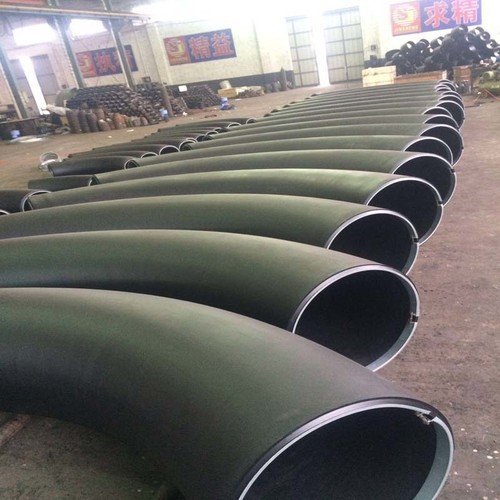
A Real Shipment Case: ASME B16.49 Bends Delivered to Chile
A practical example of our production and export capability is a large-volume shipment of ASME B16.49 bends to a customer in Chile.
The order required RAYOUNG to handle a substantial quantity of industrial pipeline components for the customer’s project. For a bulk order of this type, production consistency is just as important as the basic product specification. Before shipment, the products were subject to batch inspection covering key items such as dimensions, wall thickness, bevel ends, and surface condition.
The finished bends were then securely packed for ocean transportation and loaded for shipment to Chile. The successful delivery demonstrated our ability to coordinate large-volume ASME B16.49 bend production, quality control, export packaging, and international logistics as one supply process.
The customer accepted the shipment and recognized RAYOUNG’s ability to handle large-volume industrial orders reliably.
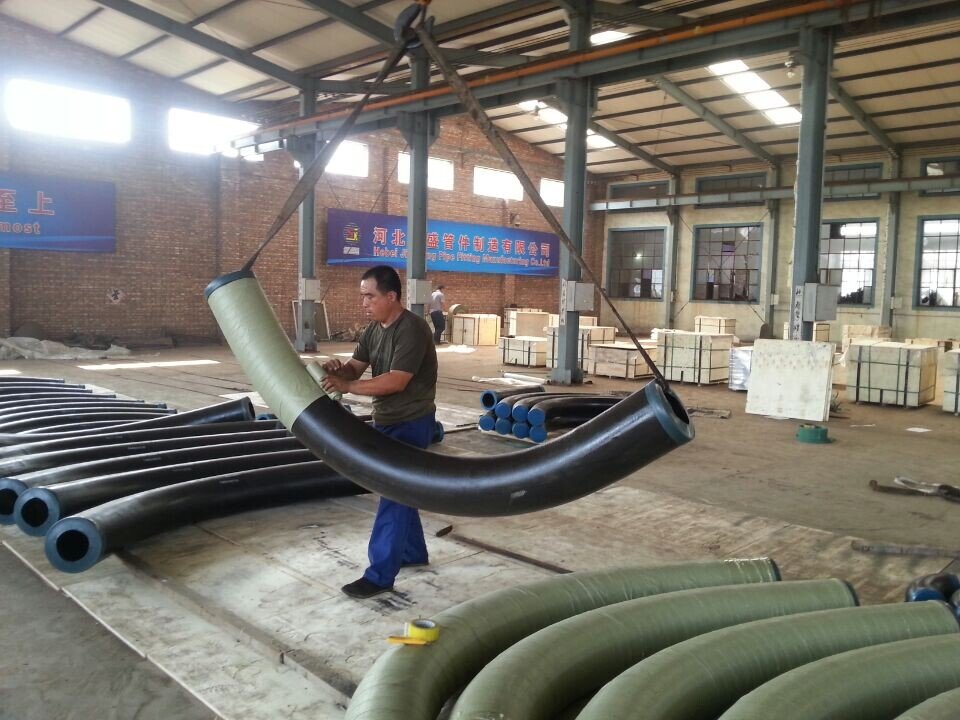
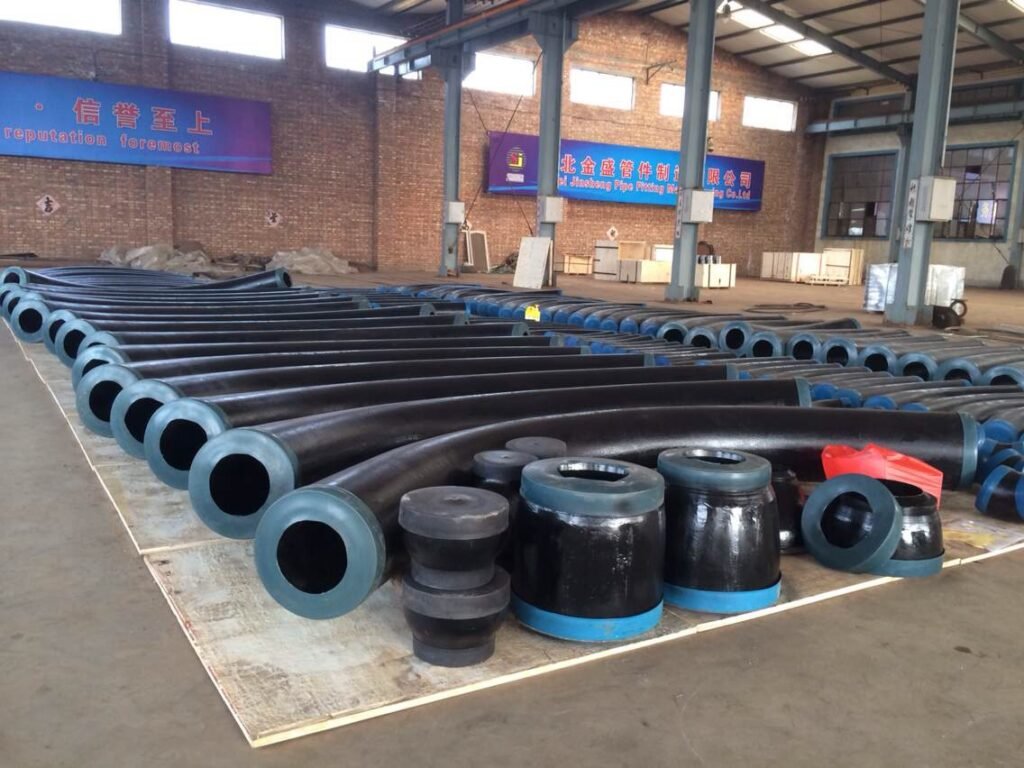
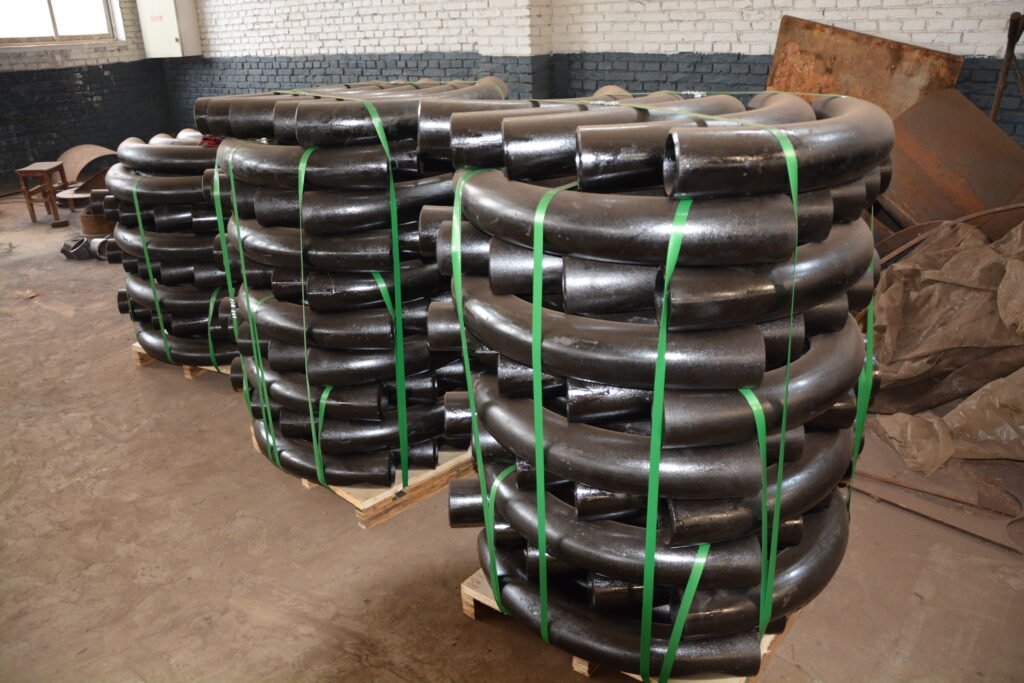
For overseas distributors, traders, and engineering contractors, this type of order is also a good example of why choosing an experienced ASME B16.49 bend manufacturer matters. Large pipeline orders require more than manufacturing capacity; they require consistent quality from the first piece to the last, accurate documentation, and reliable delivery coordination. The customer accepted the shipment and recognized RAYOUNG’s ability to handle large-volume industrial orders reliably.
ASME B16.49 Bend Manufacturer for Industrial Pipeline Projects
RAYOUNG supplies industrial steel pipe bends, buttweld fittings, carbon steel forged flanges, seamless pipes and welded pipes for overseas distributors, traders, and engineering projects.
Our production base covers approximately 35,000 m², with a team of more than 100 employees and annual output of about USD 30 million. Monthly export shipments exceed 90 containers, with a reported on-time delivery rate of 95%.
For project orders, RAYOUNG can work according to the required pipe size, wall thickness, material grade, bend radius, angle, tangent length, inspection requirements, and documentation.
We also support third-party inspection by organizations such as SGS and TÜV when required by the buyer or project. These are inspection services arranged for the order and should not be confused with holding SGS, BV, or API certifications.
For an ASME B16.49 bend quotation, send us the pipe size, material grade, wall thickness, bend radius, angle, tangent length, quantity, and applicable project specification.
Email: info@hb-steel.com
RAYOUNG — Industrial Steel Pipe Fittings, Flanges and Pipes Supplier