
In any high-pressure industrial piping system, fluid dynamics are rarely linear. Pipes of different diameters must be connected safely to manage flow velocity, pressure drops, and spatial constraints. This is where pipe reducers and fittings play a critical role.
While the general term “pipe reducer” often brings to mind large butt-weld components, engineers working with small-bore high-pressure lines rely heavily on the ASME B16.11 standard. In this guide, we will break down the complexities of ASME B16.11 pipe reducers, compare various reducer fittings and types, and explain how to select the right components for your specific infrastructure.
1. What Exactly is a Pipe Reducer?
A pipe reducer is a specialized fitting that connects a larger bore pipe to a smaller bore pipe. The primary function is twofold:
- Adapting the piping size to match equipment inlet/outlet requirements.
- Adjusting the flow rate and pressure within the system.
In the world of pipe reducers and fittings, there is a major distinction between ASME B16.9 (Butt-weld) and ASME B16.11 (Forged). ASME B16.11 specifically covers forged fittings that are either Socket Weld or Threaded. These are typically used for pipes with a nominal size of NPS 4 and smaller, where structural integrity under high pressure is non-negotiable.
2. Core Reducer Fittings and Types: Concentric vs. Eccentric Reducer
When sourcing reducer fittings and types, the most common decision involves the geometry of the reduction. Understanding the “why” behind these shapes is essential for system longevity.
Concentric Reducers (The Standard Choice)
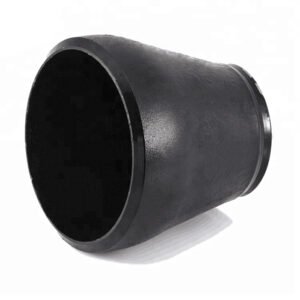
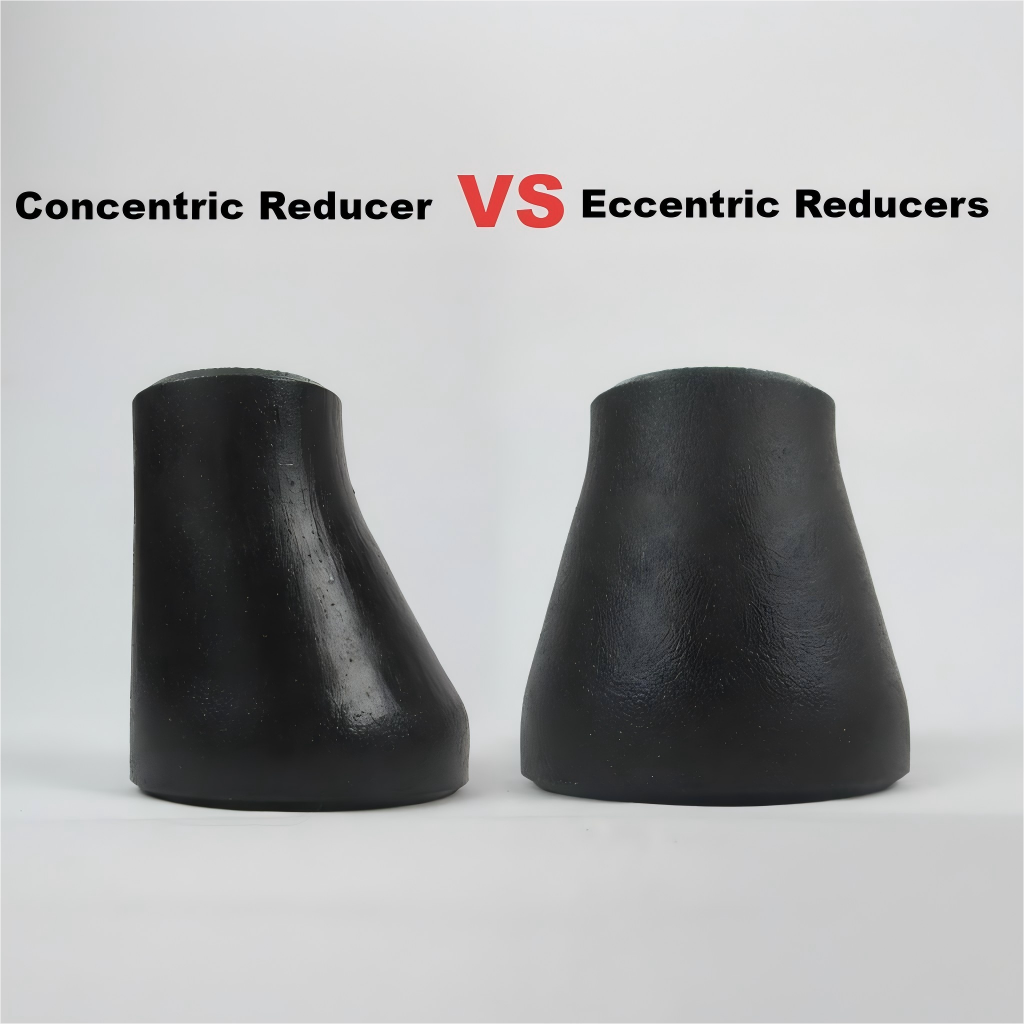
A concentric reducer is shaped like a cone. The centerlines of both the larger and smaller pipes remain aligned.
- Best For: Vertical piping runs.
- The Advantage: It allows for a smooth transition of fluid with minimal turbulence.
- The Limitation: If used in horizontal liquid lines, air or gas bubbles can become trapped at the top of the fitting, potentially causing pump cavitation.
Eccentric Reducers (The Precision Choice)
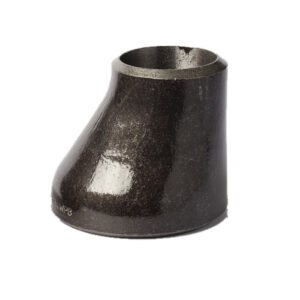
In an eccentric reducer, one side of the fitting is flat (the “flat side”), and the other is tapered. This means the centerlines of the two pipes are offset.
- Best For: Horizontal piping runs, particularly at the suction side of pumps.
- Flat Top vs. Flat Bottom:
- Flat Top: Prevents air pockets in pump suction lines.
- Flat Bottom: Allows for complete drainage of liquids in steam lines or chemical headers.
3. Deep Dive: ASME B16.11 Pipe Reducers & Forged Fittings
While “reducer” is a broad term, ASME B16.11 pipe reducers manifest in specific forged formats that differ from standard butt-weld reducers. In the forged world (ASME B16.11), we primarily deal with the following components:
Swage Nipples
Often considered the “reducer” of the forged fitting world, swage nipples are used to connect butt-weld systems to forged socket weld or threaded systems. They come in Concentric (CSN) and Eccentric (ESN) variations.
Hexagon Bushings (Threaded Reducers)
In threaded ASME B16.11 systems, a Hex Bushing acts as a reducer. It allows a smaller pipe to be screwed into a larger fitting. Because they are forged, they can handle significantly higher pressures than standard malleable iron hardware store fittings.
Reducer Inserts (Socket Weld)
A Socket Weld Reducer Insert is a clever solution for reducing the size of a socket weld fitting. Instead of replacing the entire fitting, the insert is welded into the socket of a larger fitting (like a tee or elbow), allowing a smaller pipe to be inserted.

4. Pressure Ratings: The 2000#, 3000#, and 6000# Standards
One of the most critical aspects of ASME B16.11 pipe fittings is their pressure-temperature rating. Unlike pipes, which are measured by “Schedule” (Sch 40, Sch 80), forged fittings are categorized by their Class:
- Class 2000: Primarily for threaded fittings.
- Class 3000: The industry standard for both threaded and socket weld fittings.
- Class 6000 & 9000: Reserved for extreme high-pressure environments like hydraulic systems or heavy chemical processing.
Matching the pressure class of your ASME B16.11 pipe reducers to your pipe schedule is vital. For example, a Class 3000 socket weld fitting is generally considered compatible with Schedule 80 pipe.
5. Material Selection for Forged Reducer Fittings
The performance of pipe reducers and fittings is only as good as the alloy they are made from. At HB-Steel, we emphasize matching the material to the media and temperature.
Carbon Steel (ASTM A105)
This is the most common material for ASME B16.11 pipe fittings. A105 is a forged carbon steel ideal for non-corrosive service from ambient to high temperatures.
Stainless Steel (ASTM A182 F304/L, F316/L)
For systems dealing with moisture, chemicals, or food-grade requirements, stainless steel is mandatory.
- F316L is preferred for marine environments or highly acidic conditions due to its molybdenum content.
- F304L provides excellent value for general corrosion resistance.
Alloy Steel (ASTM A182 F11, F22, F91)
Used in power plants and refineries where “Creep” resistance is required due to extremely high operating temperatures.
6. Installation Best Practices: Avoiding Common Failures
A high-quality ASME B16.11 pipe reducer can still fail if the installation is subpar. Here are technical tips for your field team:
- The 1/16″ Gap Rule: When installing socket weld reducers, the pipe should not be “bottomed out” against the shoulder of the fitting. A 1/16 inch (1.5mm) gap should be left before welding to allow for thermal expansion and prevent weld cracking.
- Thread Sealant Compatibility: For threaded ASME B16.11 pipe reducers, always use a PTFE tape or pipe dope that is chemically compatible with the fluid. Avoid over-tightening, which can stress the forged body and lead to hairline fractures.
- Proper Alignment: Especially with eccentric reducers, ensure the “flat side” is positioned correctly (up or down) according to the P&ID (Piping and Instrumentation Diagram).
7. How to Read an MTC (Mill Test Certificate) for Reducers
When you purchase ASME B16.11 pipe reducers, they should always come with an MTC. To ensure you are getting genuine forged quality, check for:
- Heat Number: Must match the stamp on the fitting.
- Mechanical Properties: Yield strength, tensile strength, and elongation must meet ASTM standards.
- Chemical Analysis: Verification of Carbon, Manganese, and Silicon levels.
- Hardness Testing: Essential for NACE-compliant fittings used in “sour” (H2S) service.
8. Why Choose HB-Steel for Your Pipe Reducers and Fittings?
Navigating the specifications of ASME B16.11 pipe fittings requires more than just a part number; it requires technical expertise.
At HB-Steel, we specialize in providing high-integrity ASME B16.11 pipe reducers that stand up to the most demanding industrial environments. Our inventory includes:
- Full range of Reducer fittings and types in Carbon, Stainless, and Alloy steel.
- Strict adherence to dimensional tolerances defined by ASME B16.11.
- Complete documentation and traceability for every component.
Whether you are designing a compact skid-mounted system or maintaining a massive refinery, our engineering team is here to ensure you select the most efficient and cost-effective reduction solutions.
FAQ: Quick Hits for Pipe Reducers
Q: Can I use an ASME B16.11 forged reducer in a butt-weld system?
A: Not directly. You would typically use a Swage Nipple to transition from a butt-weld (B16.9) end to a forged (B16.11) socket or threaded end.
Q: What is the difference between a reducer and a transition?
A: In general piping, they are the same. However, “transition” is a broader term, while “reducer” specifically refers to the fitting that changes the diameter.
Q: Are ASME B16.11 reducers available in large diameters?
A: No. ASME B16.11 is generally limited to small-bore piping (up to 4-inch). For larger sizes, you must switch to ASME B16.9 butt-weld reducers.
Ready to secure your piping system?
ContactUs for a comprehensive quote on ASME B16.11 pipe reducers and our full catalog of forged fittings. Our technical experts are ready to assist with your material selection and dimensional requirements.