
In any industrial piping system, the ability to redirect flow efficiently while maintaining structural integrity is crucial. Carbon steel butt weld elbows are the most critical components used to change the direction of a pipeline by 90 or 45 degrees.
At Rayoung, we manufacture high-performance elbows designed to withstand high pressure and thermal stress. This guide breaks down the essential technical knowledge you need for accurate procurement and engineering design.
Carbon Steel Elbows Types by Angle
The angle of an elbow determines the degree of directional change in the piping run.
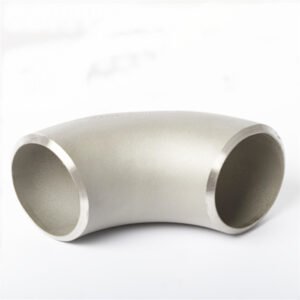
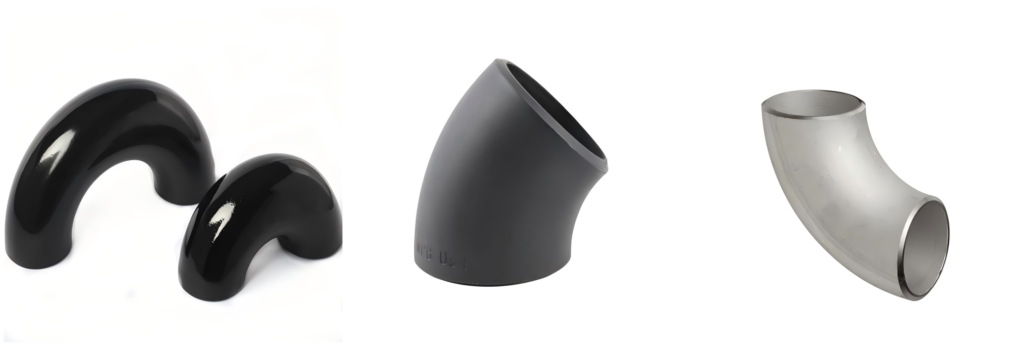
- 90 Degree Elbow: The most common fitting, used to change the pipe direction by 90°. It is available in both Long Radius and Short Radius versions.
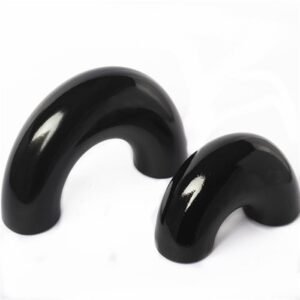
- 45 Degree Elbow: Used for subtle turns in the pipeline. These are typically manufactured as Long Radius elbows to ensure smooth flow with minimal pressure drop.
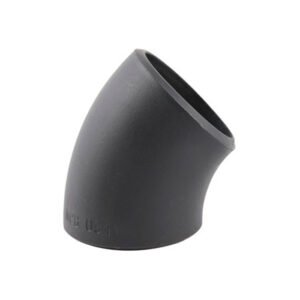
- 180 Degree Elbow (U-Bends): Primarily used in heat exchangers and boiler systems to reverse the flow direction.
Long Radius (LR) vs. Short Radius (SR) Elbows
Understanding the “Radius” is the most common point of confusion during procurement.
Long Radius (LR) Elbows: The radius of curvature is 1.5 times the nominal pipe diameter (R=1.5D).
Advantage: Lower friction resistance and smoother flow. This is the industry standard for most pressure piping.
Short Radius (SR) Elbows: The radius is equal to the nominal pipe diameter (R=1.0D).
Advantage: Ideal for tight, compact spaces where a standard LR elbow won’t fit. However, expect a higher pressure drop.
Material Grade: Why ASTM A234 WPB?
For most industrial applications involving carbon steel, ASTM A234 Grade WPB is the gold standard.
Mechanical Strength: It offers excellent tensile strength and yield points.
Weldability: The “W” stands for weldable, “P” for pressure, and “B” refers to the grade. It is designed for use in moderate to high-temperature service.
Heat Treatment: At HB Steel, our A234 WPB elbows undergo normalized heat treatment to ensure a uniform grain structure and eliminate internal stresses.
Dimensional Standards: Navigating ASME B16.9
To ensure seamless fit-up on the job site, all butt weld elbows must adhere to the ASME B16.9 standard. This standard governs:
- Center-to-End dimensions.
- Wall thickness (Schedules like Sch 40, Sch 80/XS, Sch 160).
- Tolerances for angularity and alignment.
- Beveling (ASME B16.25): Every elbow from HB Steel is supplied with precision-beveled ends. This ensures that when the elbow meets the Carbon Steel Pipe, the welder has a perfect “V” groove for full-penetration welding.
Procurement Checklist: Avoiding Common Ordering Errors
When requesting a quote for carbon steel elbows, ensure you provide these five critical specs:
Angle: 90°, 45°, or 180°.
Radius: Long Radius (LR) or Short Radius (SR).
Size (NPS/DN): e.g., 6” or DN150.
Schedule (Wall Thickness): Sch 40, STD, Sch 80, XS, etc.
Seamless vs. Welded: Seamless is preferred for high-pressure service; welded (from plate) is common for large-diameter low-pressure lines.
Why Global Projects Trust our Elbows?
Quality control is the difference between a system that lasts 30 years and one that fails in five. Our quality process includes:
Visual & Dimensional Inspection: Ensuring every piece meets ASME B16.9.
Non-Destructive Testing (NDT): Ultrasonic or Radiography testing available upon request.
Surface Protection: Every elbow is coated with anti-rust oil or black paint and clearly marked with heat numbers for full traceability.
Looking for a reliable carbon steel elbow supplier for your next project?
Contact us for a competitive quote, or view our Elbow Weight and Dimension Charts.