
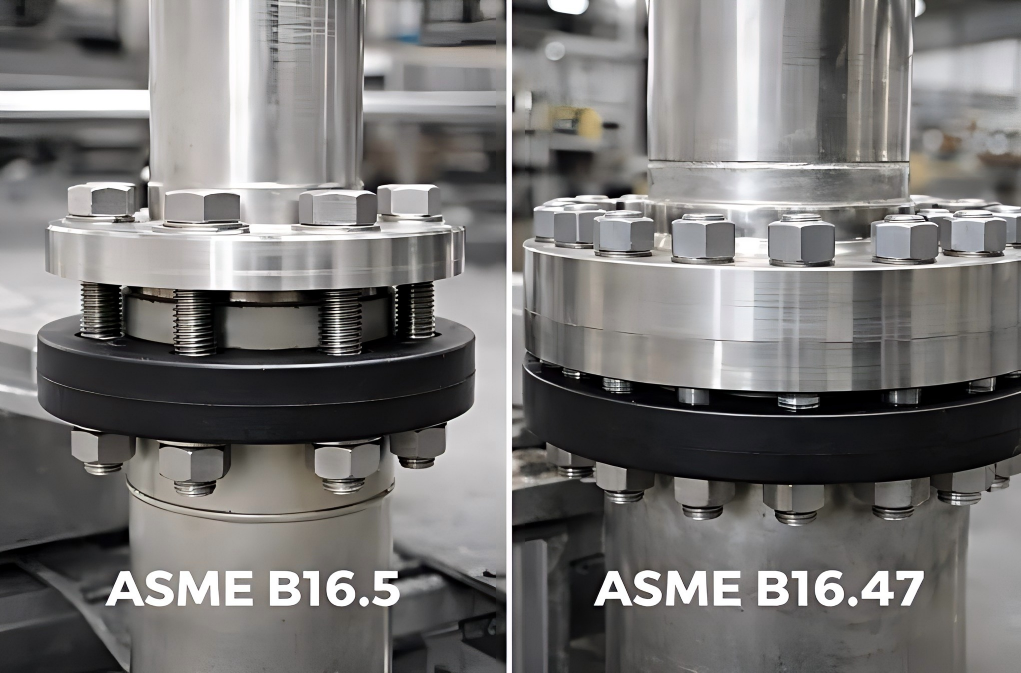
When your piping project involves large diameters—specifically anything over 24 inches—ASME B16.5 is no longer the standard you need. This is exactly where ASME B16.47 comes in.
However, once you step into B16.47 territory, you immediately face a choice: Series A or Series B? Here is a clear breakdown to help you understand the differences.
What Is ASME B16.47?
ASME B16.47 is the dedicated standard for large-diameter steel pipe flanges, covering sizes from 26″ up to 60″. It strictly applies to weld neck flanges and blind flanges. The standard includes pressure classes 75, 150, 300, 400, 600, and 900. Because it uses the same materials as B16.5 (except for nickel alloys), the pressure-temperature ratings are generally identical.
Why do we need a separate standard? It’s simple. The dimensions in B16.5 max out at 24 inches. Large-scale pipelines, petrochemical plants, and power generation facilities require bigger pipes, so the ASME/ANSI B16.47 standard was created to fill this gap.
Unlike most standard specs, B16.47 is split into two distinct categories: Series A and Series B. Each has its own dimensions, bolt patterns, and design focus.
ASME B16.47 Series A Flanges: The Heavy-Duty Choice
ASME B16.47 Series A originated from MSS SP-44. If you ever see drawings calling for large “MSS SP-44 flanges,” they are now officially B16.47 Series A.
These flanges are built tough. Compared to Series B, Series A flanges feature a larger outside diameter (OD) and use fewer, but thicker, bolts. This beefy design—with a wider bolt circle and heavier bolts—makes Series A the go-to choice when your piping system faces heavy external loads. It is designed to handle internal pressure alongside bending moments, thermal expansion, and the sheer physical weight of large-bore pipes. When engineers don’t specify, Series A is usually the industry default.
Another key feature: Series A supports Ring-Type Joint (RTJ) faces for Class 300 through 900. If your specs demand RTJ in a large diameter, Series A is your only option here.
Common applications for Series A:
- New pipeline construction (especially oil & gas).
- High-pressure/high-temperature systems with heavy external loads.
- Projects requiring RTJ sealing in large diameters.
- Systems maintaining dimensional matching with older MSS SP-44 setups.
ASME B16.47 Series B Flanges: The Compact, Bolt-Dense Choice
ASME B16.47 Series B comes from the old API 605 standard. Just like Series A, “API 605 flanges” are now simply called B16.47 Series B.
Many in the industry call Series B “compact flanges” because they are dimensionally lighter. They have a smaller outside diameter and a tighter bolt circle. To make up for the smaller size, Series B uses more bolts that are smaller in diameter.
Why pack bolts closer together? It creates a stiffer bolted joint and minimizes flange rotation after installation. This is highly beneficial in systems where you worry about gasket creep or joint relaxation over time.
The tradeoff? Series B does not offer RTJ faces under the B16.47 standard, and it can’t handle the same extreme external physical loads as Series A. However, if your main concern is just internal pressure, Series B is a lighter and much more cost-effective solution.
Additionally, Series B includes Class 75, which Series A does not. This is highly useful for low-pressure or vacuum applications where keeping the total assembly weight down is critical.
Common applications for Series B:
- Repair and replacement on older systems built to API 605.
- Piping systems where internal pressure is the main factor and external loads are low.
- Low-pressure systems requiring Class 75 ratings.
- Projects where budget and weight savings are prioritized.
Quick Comparison: Series A vs. Series B
| Feature | Series A (MSS SP-44) | Series B (API 605) |
| Origin Standard | MSS SP-44 | API 605 |
| Outside Diameter | Larger | Smaller |
| Bolt Count & Size | Fewer, larger bolts | More, smaller bolts |
| Bolt Circle | Larger | Smaller |
| RTJ Face | Supported (Class 300–900) | Not Supported |
| Class 75 Option | No | Yes |
| Overall Weight | Heavier | Lighter |
| External Load Capacity | Higher | Lower |
| Best For | New builds, heavy loads | Retrofits, weight/cost savings |
Which Series Do You Need?
The golden rule is: Always follow the project spec. Series A and Series B are not interchangeable. Their outside diameters and bolt patterns are completely different. You cannot bolt a Series A flange to a Series B flange without custom modifications.
If you are designing a new system, consider these factors:
- External Loads: If the pipes face thermal expansion, heavy equipment connections, or bending moments, choose the heavier Series A.
- Face Type: Need an RTJ face? You must use Series A.
- Cost and Weight: If external loads are minor and you want to save on material costs and assembly weight, Series B is the smart choice.
- System Maintenance: If you are replacing parts on an existing line, you must match what is already there.
(Expert Tip: Large-diameter flanges are high-value items. Getting the series wrong means costly delays. Always double-check with your piping engineer before placing an order.)
A Quick Note on B16.47 Flange Types
Remember, ASME B16.47 only covers weld neck and blind flanges.
If you need a large-diameter slip-on flange, you are technically stepping outside of the B16.47 standard. You will need to look at B16.1 (for cast iron) or use custom-designed flanges. At Rayoung/JS Fittings we supply large-diameter slip-on flanges built to standard industry designs, but they require your engineer’s approval for specific applications.
For standard Series A and Series B weld neck and blind flanges, you can find full dimensional data and weights in our online catalog, or contact our team directly for custom flange solutions.