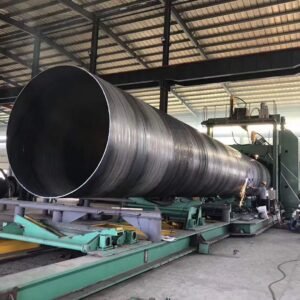

In the high-stakes world of oil and gas exploration, the margin for error is non-existent. The infrastructure used to drill, extract, and transport energy resources must withstand immense pressures, scorching temperatures, and highly corrosive elements. This is where API (American Petroleum Institute) steel pipes become the industry’s most valuable asset.
Whether involved in upstream drilling or downstream refining, understanding the specific standards and applications of API pipes is vital for ensuring operational safety and long-term project viability.
What is API Pipe?
Simply put, an API pipe is not just a steel tube; it is an engineered component manufactured to the stringent specifications set by the American Petroleum Institute. These standards exist to guarantee consistency, durability, and safety across the global energy sector.
Unlike standard commercial piping, API-certified materials are tested to survive the harshest conditions on the planet—from deep-sea trenches to high-pressure underground reservoirs.
Key API Pipe Standards You Need to Know:
Selecting the correct pipe begins with understanding the specific API standard governing its use. Different operations require different mechanical properties. Here are the four critical standards used in the industry:
- API 5L :
This is the most common specification for Line Pipe. API 5L covers seamless and welded steel pipes used to transport oil, gas, and water.
Best for: Transmission pipelines connecting extraction sites to refineries.
Key Feature: Available in two specification levels (PSL1 and PSL2) to match specific pressure and chemical requirements. - API 5CT
Focused on OCTG (Oil Country Tubular Goods), API 5CT specifies requirements for Casing and Tubing.
Casing: Stabilizes the borehole to prevent collapse.
Tubing: Transports the crude oil or natural gas to the surface.
Key Feature: Manufactured in various grades (such as J55 or P110) to resist specific threats like sour gas (H2S) corrosion or extreme depth pressure. - API 15LR
This standard covers Fiberglass Reinforced Plastic (FRP) pipes.
Best for: Low-pressure environments where metal corrosion is a primary concern.
Key Feature: Lightweight and inherently resistant to rust and chemical degradation. - API 17J
This specification governs unbonded flexible pipe systems.
Best for: Deepwater and subsea applications where pipes must bend with ocean currents and uneven seabeds.
Key Feature: High fatigue resistance and adaptability to dynamic marine environments.
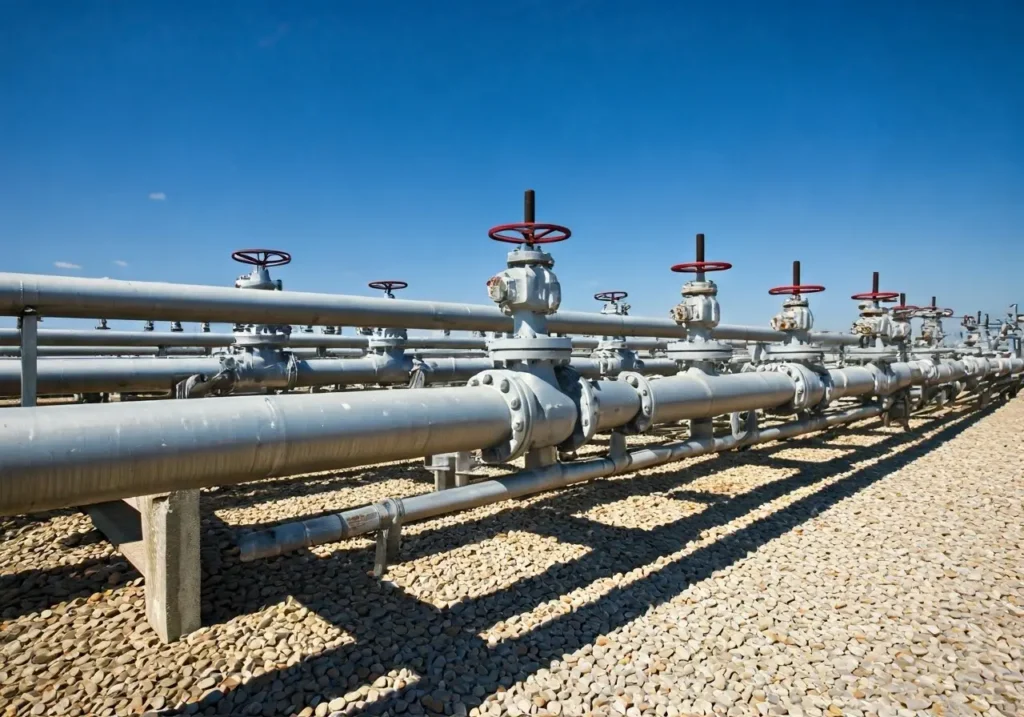
API 5L: Seamless Pipe vs. Welded Pipes
When dealing with transmission lines (API 5L), engineers generally choose between two manufacturing methods based on budget and pressure requirements.
Seamless Pipes (SMLS)
Manufactured from a solid steel billet without any welding seams, these pipes offer superior structural integrity.
The Advantage: Higher pressure tolerance and uniformity.
Ideal Use: Critical offshore lines, high-pressure risers, and sour service environments where a weld seam could be a point of failure.
Welded Pipes (ERW/LSAW)
Formed by rolling steel plates and welding the seam, these pipes are cost-effective and readily available in large diameters.
The Advantage: Lower cost and tighter dimensional control for large pipelines.
Ideal Use: Onshore transmission lines and lower-pressure transport systems.
Note: API 5L pipes are categorized by yield strength, ranging from Grade B to high-strength X80 (where “80” represents 80,000 psi minimum yield strength).
Critical Applications in the Oil & Gas Sector
API pipes are the arteries of the energy industry. Their application changes depending on the stage of the project:
Drilling Operations
Before production begins, API 5CT Casing is essential. It lines the wellbore, protecting groundwater from contamination and preventing geological formations from crushing the well.
Production Phase
Once the well is secured, API 5CT Tubing is inserted. This is the conduit through which hydrocarbons travel to the surface. In environments with high sulfur content or extreme heat, specialized alloy grades are used to prevent catastrophic leaks.
Subsea & Offshore Transport
Connecting an offshore rig to the mainland requires pipes that can survive the crushing weight of the ocean. API 5L Seamless pipes and API 17J flexible pipes are utilized here to handle the cold temperatures and dynamic movement of the sea.
Midstream Transportation
To move crude oil and natural gas across continents, vast networks of API 5L welded pipes are deployed. These pipelines prioritize efficiency and flow assurance to keep the global energy supply chain moving.
Optimizing Your Operations with the Right Piping
Choosing the wrong pipe grade or standard can lead to expensive downtime, environmental hazards, and safety risks. Whether you need high-grade casing for a deep well or durable line pipe for cross-country transport, expert guidance is key.
Looking for reliable, API-certified piping solutions?
Rayoung has more than 30 years of experience industry the steel pipes industry to help you navigate complex specifications.
Contact us today to discuss how we can support your project with pipes designed for performance and longevity.
+86-18003119682
info@hb-steel.com