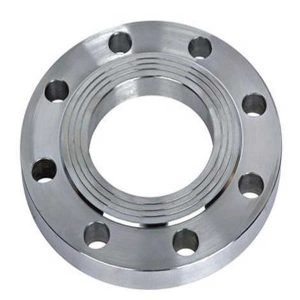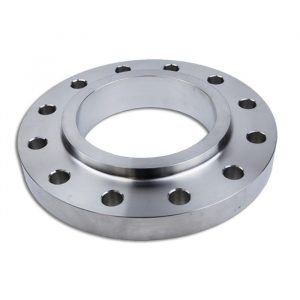

Both are slip-on flanges. The only physical difference is the hub: a plate flange is a flat disc, while a slip-on has a short hub rising from the face. That one feature changes the price, the weld, the inspection method and — most importantly for procurement — whether the part passes when it arrives on site.
The part that makes this comparison dangerous is that a plate flange and a hubbed slip-on can share the same bolt circle. It will bolt up. That is why the wrong one gets shipped, accepted and then rejected three weeks later by the inspector.
The difference, without the textbook language
| Plate flange | Hubbed slip-on | |
| Body | P235GH | Disc with a short hub, normally forged |
| Standard home | EN 1092-1 Type 01, JIS B2220 (SOP), AS 2129, DIN 2576 | ASME B16.5 SO, EN 1092-1 Type 12,JIS B2220 (SOH) |
| Pipe joint | Two fillet welds on a thin edge | Two fillet welds, the outer one against the hub |
| Fit-up | Fit-up and bolt-hole alignment may require more careful positioning, depending on bore clearance and installation conditions. | The hub provides a more substantial welding profile, while fit-up adjustment still depends on the actual dimensions and assembly clearance. |
| Cost | Lowest of any flange type | Higher — more steel, forging, machining |
| Stock risk | Looks similar in a box; wrong one is hard to spot without checking the hub | Same |
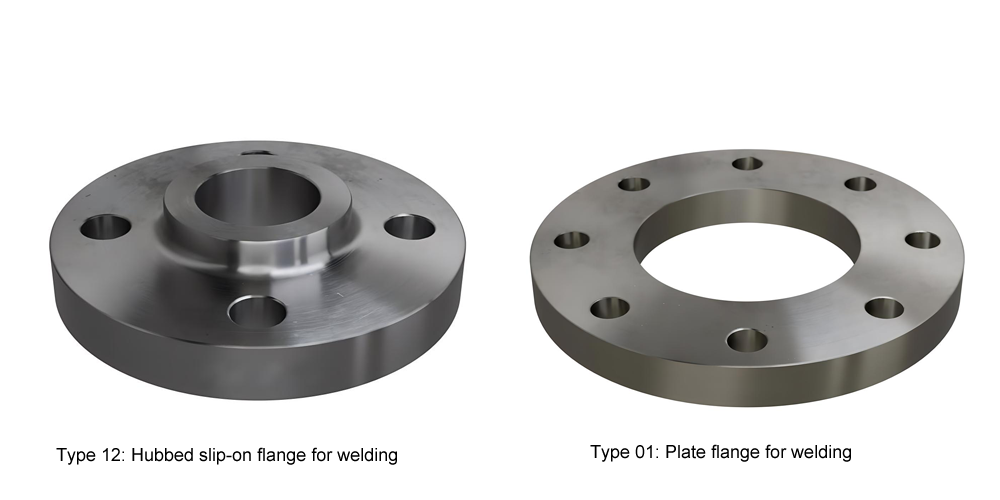
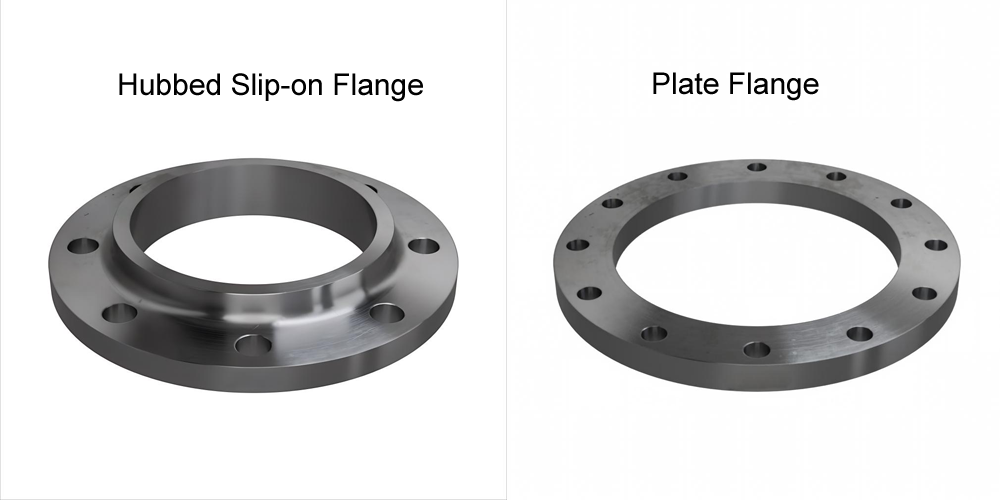
The hub is not decoration. It is material put exactly where bending stress concentrates — at the pipe-to-flange junction — and it gives the outside fillet weld a shoulder to sit against instead of a thin plate edge.
Where buyers actually lose money
The quote says slip-on, the container holds plate flanges. This is the most common version of this problem, and it happens because “slip-on flange” is treated as a generic word. A supplier quoting a low price can deliver a hubless disc, save the forging cost and still meet the bolt pattern. On a class 150 water line it may work. On a line where the specification called for a forged SO with a hub, it is a rejected delivery, a re-order and a schedule hit. Write the type into the PO, not just the size and class.
The standard does not say what the name implies. ASME B16.5 defines a slip-on with a hub. It does not define a hubless plate slip-on — the plate version sold against B16.5 dimensions is a project-specific cost-saving variant, and on a code job it is a deviation that needs design approval. In the EN system the distinction is written into the standard: Type 01 is the plate flange, Type 12 is the hubbed slip-on. A line that reads “plate flange, ASME B16.5, Class 150” needs a question asked before it is quoted.
RF and FF get mixed up more often than the flange type. This one is worth stating plainly: a plate flange can be flat face or raised face. FF needs a full-face gasket and is common against cast iron; RF takes a spiral-wound or graphite gasket and is the general industrial choice. When connecting an RF flange to cast-iron equipment with an FF flange, the joint design and gasket arrangement must be checked carefully. Uneven contact pressure and excessive bolt loading can damage cast-iron flange faces. Confirm the equipment manufacturer’s requirements before assembly.
Inspection requirements can determine the flange type before price does. Plate flanges and conventional slip-on flanges use fillet-weld connections, which are not generally suitable for routine radiographic examination in the same way as butt welds. If your project requires volumetric examination of the pipe-to-flange joint, a weld-neck flange with a butt-weld connection may be necessary. Confirm the applicable piping code and NDE requirements before selecting the flange.
For stockists, the two types are two lines of inventory. They are not interchangeable, so carrying both doubles the stocked SKUs for the same nominal sizes. Worse, they look close enough in a packed carton that a warehouse pick can go wrong. The margin on a flange is small; the cost of one wrong pallet — return freight, claim, a customer who changes supplier — wipes out a lot of correct orders. Mark the hub on the picking list. It takes one word.
Which one should you actually specify?
- Water, HVAC, irrigation, low-pressure air and general utilities: plate flange. It does the job, it is the cheapest flange you can buy, and it is available quickly in most sizes.
- Field fit-up where bolt holes must be rotated into line, or a tight spool between fixed flanges: hubbed slip-on. The extra cost is recovered in fitting hours.
- Cyclic loading, high temperature, hazardous media, or any line requiring radiography: neither. Move to a weld-neck flange and stop comparing prices.
A distributor’s question is slightly different: stock what your customers’ drawings call for, not what is cheapest to buy. In Asian water and building-services work, plate flanges move in volume. On ASME process projects, the hubbed slip-on in Class 150 and 300 is the standard request. Mixing the two into one stock line is a false economy.
The purchase order line that prevents most of this
One line, written properly, removes most of the ambiguity:
EN 1092-1 Type 01, DN100, PN16, Type B (RF), P250GH, EN 10204 3.1 — 40 pcs, to suit pipe OD 114.3 mm
or, for the other type:
ASME B16.5, NPS 4, Class 150, RF, slip-on with hub, ASTM A105, EN 10204 3.1 — 40 pcs, to suit pipe OD 114.3 mm
Standard, size, rating, type, facing, material, certificate, pipe OD, quantity. If the supplier comes back with a question, that is a good sign. If they come back with a price immediately, check what they assumed.
Frequently asked questions
Is a plate flange a slip-on flange? Yes, in the broad sense — the pipe slips through the bore and two fillet welds hold it. In purchasing terms they are different parts: “plate flange” means the flat, hubless version, while “slip-on” usually means the hubbed type.
What is the physical difference between a plate flange and a slip-on? The hub. A plate flange has none; a hubbed slip-on has a short hub at the back of the face that adds stiffness at the pipe junction and gives the outer weld a shoulder.
Which is cheaper, a plate flange or a slip-on flange? Plate flanges are generally more economical than comparable hubbed slip-on flanges because their simpler hubless construction can reduce material usage and machining requirements. Actual cost depends on flange size, material grade, thickness, manufacturing method and order quantity.
Is a plate flange available to ASME B16.5? Only as a project-specific hubless variant. ASME B16.5 defines the hubbed slip-on, not a plate slip-on. Get design approval before substituting one on an ASME line.
What is EN 1092-1 Type 01 vs Type 12? Type 01 is the welded plate flange; Type 12 is the hubbed slip-on. Both are in the EN system, where size is DN and rating is PN.
Can a plate flange be raised face? Yes. Plate flanges come in FF and RF. The face type is a separate decision from the flange type and must be stated on the order.
Can either type be used where radiography is required? No. Fillet welds are not radiographed. Use a weld-neck flange with a butt weld for RT inspection.
Why do some plate and slip-on flanges have the same bolt circle? Because the hub does not change the bolting geometry — it changes the stiffness and the weld detail. The parts may bolt up to the same mating flange, which is exactly why the wrong one can slip through unnoticed.
Get the type confirmed before you order
Send us the drawing or the line from your specification and we will tell you which type it calls for, and flag any line where the name and the standard disagree. Request a flange quote · Plate flanges · Slip-on flanges
- Tel/whatsapp: +86-18003119682
- Emails: info@hb-steel.com