

For piping distributors, stockists, and EPC contractors, blind flange procurement directly impacts cash flow and brand reputation. A blind flange seems like the simplest component in a piping package—it has no bore. Yet, it frequently triggers the most commercial disputes: unmatched sealing serrations, falsified MTRs, rejected wall thicknesses, or delivery delays on mixed-specification orders.
To protect margins and avoid project rejections, buyers sourcing from Chinese flange manufacturers must evaluate technical compliance, forging integrity, and documentation rather than relying purely on unit price.
1. Eliminate Specification Gaps Before Sending an RFQ
A generic inquiry for “blind flanges” guarantees mismatched quotes. To get accurate pricing on first pass, your RFQ must specify these four technical parameters:
Applicable Standards & Profiles
- ASME B16.5: Covers NPS 1/2″ to 24″, Class 150 through 2500.
- ASME B16.47 (Series A / MSS SP-44 vs. Series B / API 605): Covers large-diameter flanges (NPS 26″ to 60″). Note: Series A flanges are heavier, thicker, and use larger bolt holes than Series B. They are not interchangeable.
- EN 1092-1 (Type 05): The standard specification for European metric blind flanges (PN 6 to PN 100).
- DIN / BS / JIS / GOST: Project-specific variations.
B16.5 vs. B16.47, click here to know.
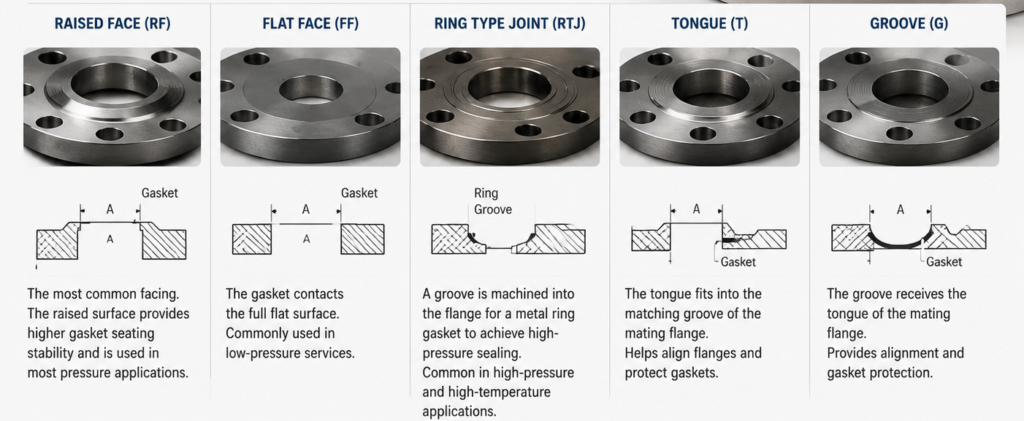
Facing Types & Surface Finish
- Raised Face (RF): The industrial standard. Ensure your supplier adheres to standard serration finishes (125–250 AARH / Ra 3.2–6.3 µm concentric or spiral serration). Smooth-faced deliveries will lead to immediate field gasket leaks.
- Flat Face (FF): Critical for mating with cast iron valves or FRP equipment to prevent flange body cracking during bolt torquing.
- Ring Type Joint (RTJ): Engineered for high-pressure/high-temperature service (Class 600+). Specify exact Octagonal or Oval ring groove tolerances.
More knowledge about flange face types; please click here.
Manufacturing Method: Forged vs. Plate Cut
- Forged (ASTM A105 / A350 LF2 / A182): Required for critical pressure applications. Better grain flow, higher yield strength, and zero internal porosity.
- Plate Cut (ASTM A516 Gr. 70 / A240): Often quoted by budget mills to lower unit costs. Ensure your client’s piping spec allows plate blind flanges before accepting this option.
Please read this blog: Forged vs. Cast Flanges
2. How to Vet a Chinese Blind Flange Factory
A standard product catalog does not prove export competence. When auditing a blind flange manufacturer, evaluate their quality infrastructure against these benchmarks:
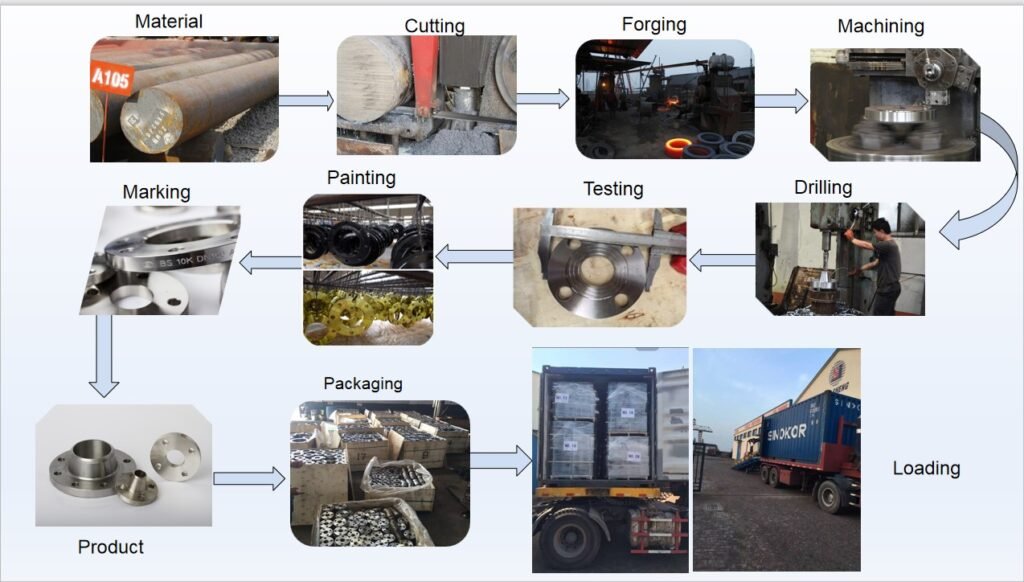
- In-House Heat Treatment (Normalizing):
For ASTM A105 carbon steel, Class 300 and above (or low-temperature A350 LF2) require verified normalizing (A105N). Verify whether the mill operates its own heat treatment furnace or outsources it. - Bolt-Hole Alignment & Pitch Circle Diameter (PCD):
Misaligned bolt holes on blind flanges ruin assembly times. The supplier should run CNC drilling with automated PCD verification to ensure mating with third-party flanges. - Traceability and Hard Stamping:
Every single flange must be clearly stamped with:
Manufacturer Logo | Standard | Size | Class | Material Grade | Heat Number
If the heat number on the flange does not trace directly to the EN 10204 3.1 Mill Test Certificate (MTR), your shipment will fail incoming QA inspection. - Rust Prevention & Packaging:
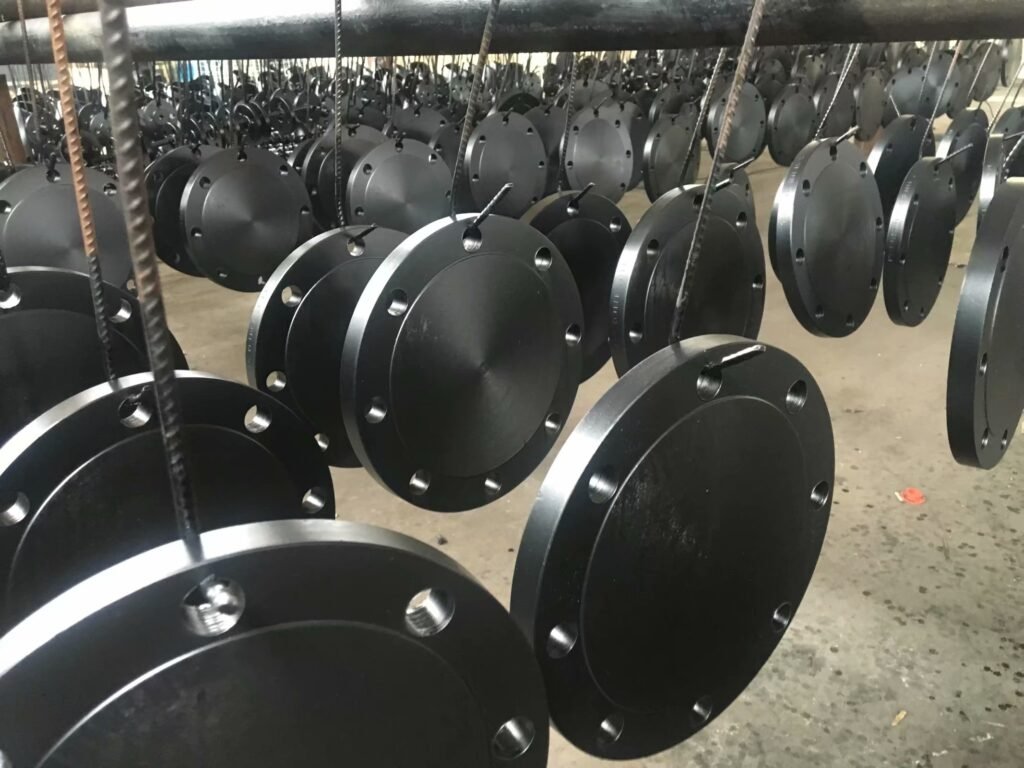
For ocean freight: Black paint, anti-rust oil, or yellow varnish must fully coat the body, while the sealing face requires specialized plastic flange protectors. Small sizes (1/2″–4″) must be securely boxed within fumigated plywood cases; sizes 6″+ require heavy wooden skids with steel strapping.
3. Stocking Strategy for Distributors: Balancing Cash Flow & Fill Rates
Stocking every blind flange variation is commercially impractical. Top-performing distributors segment their inventory into two tiers:
| Inventory Tier | Target Sizes & Classes | Materials | Purchasing Strategy |
| Tier 1: High-Turnover Fast Movers | NPS 1/2″ to 12″ Class 150 & 300 RF | ASTM A105N SS304/304L, SS316L | Bulk Stock Replenishment: Order in FCL container volumes to minimize landed freight costs per kg. |
| Tier 2: Project / Engineered Orders | NPS 14″ to 36″+ Class 600 to 2500, RTJ | A350 LF2, A182 F11/F22, Duplex 2205 | Back-to-Back Ordering: Partner with an agile factory capable of 2–3-week machining turnarounds on pre-forged blanks. |
4. Why Source Pipe Blind Flanges from Hebei Rayoung Pipeline Technology?
Hebei Rayoung Pipeline Technology Co., Ltd. manufactures and exports industrial flanges, butt weld pipe fittings, and high-pressure piping components to international stockists and engineering contractors.
- Full Production Range: ASME B16.5, ASME B16.47 (Series A & B), EN 1092-1 Type 05, and DIN blind flanges from 1/2″ to 48″.
- Pressure Ratings: Class 150 to Class 2500 / PN 6 to PN 420.
- Verified Metallurgical Quality: Carbon steel (A105N, A350 LF2), Stainless steel (F304/304L, F316/316L), and Alloy steels.
- Strict Documentation: Standard supply includes EN 10204 3.1 MTRs, third-party inspection support (SGS / BV / Intertek), and seaworthy export packaging.
Need reliable pricing for inventory stock or upcoming project bids?
[Submit Your Flange Specification List to Our Engineering Team] — Receive a detailed commercial quotation and technical confirmation within 24 hours.
Inquiry Email: info@hb-steel.com
Technical Support / WhatsApp: +86-18003119682
Frequently Asked Questions (FAQ)
What is the main structural difference between a Blind Flange and a Slip-on Flange?
A blind flange is a solid forged disk with no center bore, designed to isolate lines, cap pipe ends, or serve as access covers. A slip-on flange (SO) has a central bore sized to slide over a pipe before fillet welding. They cannot be substituted for one another.
When should I specify ASTM A105N over standard ASTM A105?
“N” denotes Normalized heat treatment. Normalizing refines grain structure, improves low-temperature impact toughness, and relieves forging stresses. Most major end-user piping specifications require A105N for Class 300 and higher, or for service temperatures down to -29°C.
ASTM A105 vs. A105N, please click this blog.
Can your factory handle mixed-size consolidation in one container?
Yes. For stockists, we routinely consolidate full packages—combining blind flanges, weld neck flanges, slip-on flanges, and butt-weld elbows/tees into organized, color-coded, labeled plywood cases to streamline your warehouse receiving process.