

- Standards: Fully compliant with ASME B16.9, B16.28, and MSS SP-75.
- Materials: Carbon Steel (A234 WPB), Stainless Steel (304/316L), Alloy Steel
- Size Range: 1/2″ to 48″ (Seamless), up to 72″ (Welded).
- Core Value: material traceability with 3.1 MTR, precision CNC beveling, and zero-leak integrity for high-pressure systems.
1. What is a Butt Weld Pipe Fitting?
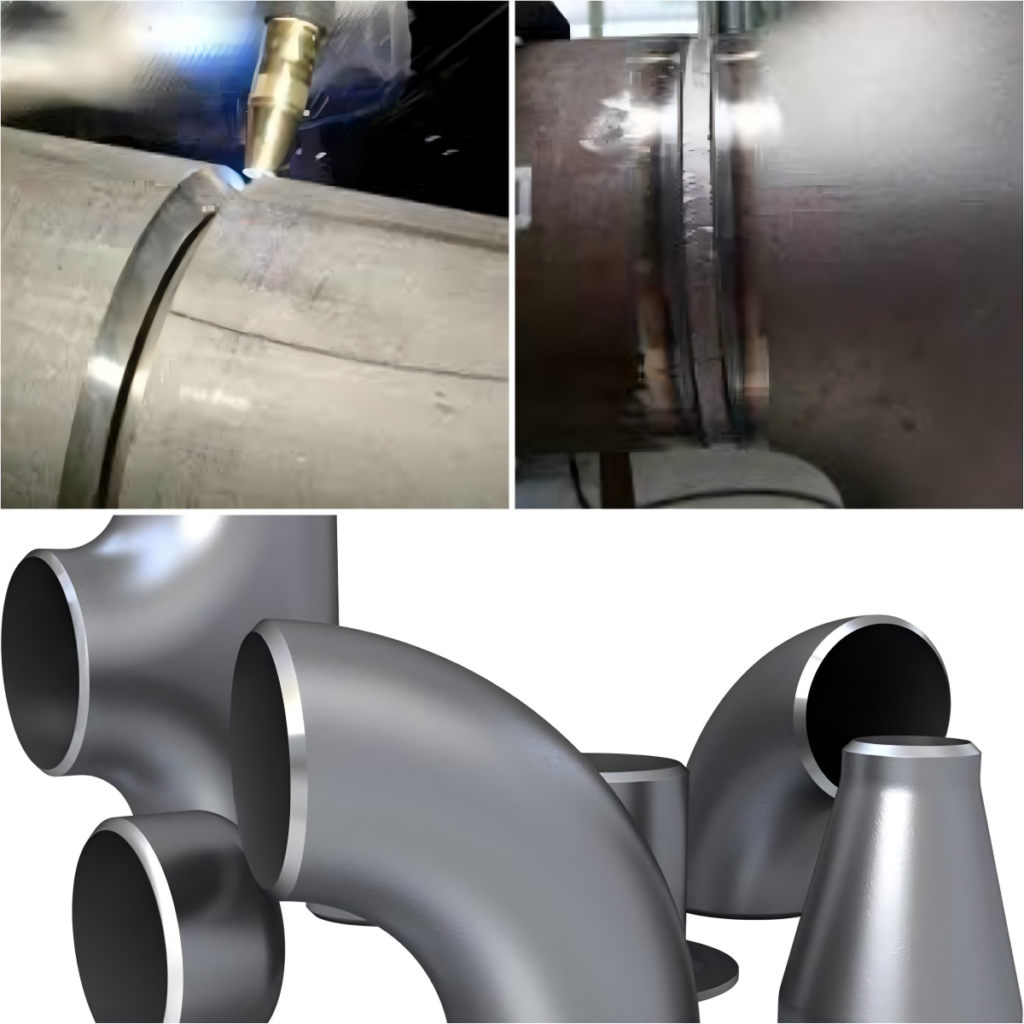
A butt weld pipe fitting is a weldable industrial component used to change flow direction, branch off, or adapt pipe diameters. Unlike threaded or socket weld fittings, butt weld ends are beveled to allow for full-penetration welds. This creates a robust, permanent metal-to-metal connection, making them the industry standard for high-pressure, high-temperature, and corrosive piping systems.
At RAYOUNG, we don’t just supply steel pipe fittings; we provide flanges and steel pipes that ensure the structural integrity of your entire pipeline.
2. Butt Weld Fittings Types
We manufacture a complete range of geometries to meet complex piping ISO requirements:
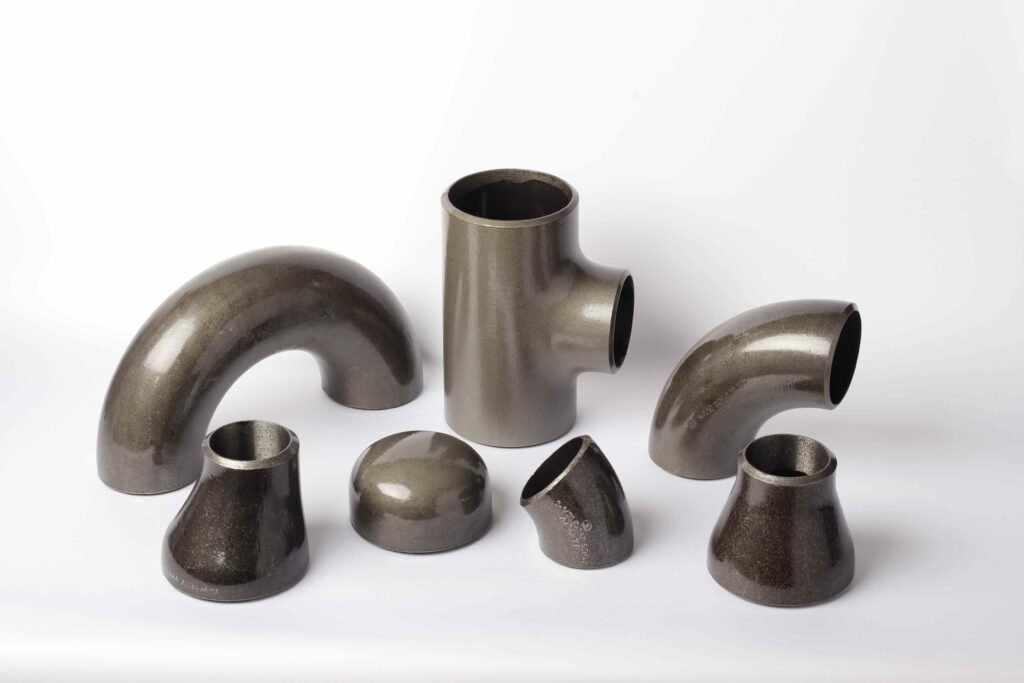
- Elbows (45°, 90°, 180°): Available in Long Radius (LR) for smooth flow and Short Radius (SR) for tight spaces.
- Tees (Equal & Reducing): High-strength branching solutions for 90-degree junctions.
- Reducers (Concentric & Eccentric): Precision-tapered components for changing pipe diameters while managing flow velocity.
- Pipe Caps: Deep-drawn or forged caps for permanent end-sealing.
- Stub Ends: Designed for use with lap joint flanges to facilitate easy system cleaning and inspection.
3. Technical Specifications & Material Grades
| Feature | ASME B16.9 Standard Requirement | We ManufacturingOur Capability |
| Size Range | 1/2″ – 48″ | Up to 72″ (Large Diameter Specialist) |
| Schedule (WT) | Sch 10s to Sch XXS | Custom Wall Thickness up to 100mm |
| Carbon Steel | ASTM A234 WPB, WPC | Low Temp (A420 WPL6), High Yield (WPHY) |
| Stainless Steel | ASTM A403 WP304/L, WP316/L | WP317, WP321, WP347 |
| End Preparation | Beveled per ASME B16.25 | Plain, Root Face, or Custom Bevel Angles |
4. Critical Challenges & Our Solutions
In heavy industry, a minor mismatch in fitting quality can lead to catastrophic downtime. Here is how we solve common industry pain points:
Problem: Wall Thickness & Bevel Mismatch
- Issue: Fittings often arrive with inconsistent wall thicknesses that don’t match the pipe, leading to poor weld penetration.
- Solution: We utilize CNC precision machining for all bevel ends. Our fittings are calibrated to your specific pipe schedule, ensuring a perfect “V” groove for 100% penetration welding.
Problem: Internal Corrosion & Cracking
- Issue: Residual stress from the forming process can lead to Stress Corrosion Cracking (SCC).
- Solution: All our pipe fittings undergo Full Heat Treatment (Normalizing or Solution Annealing) to restore mechanical properties and ensure long-term durability in harsh environments.
Problem: Lack of Material Traceability
- Issue: Many suppliers provide mixed-grade materials without proper documentation.
- Solution: We implement a strict Heat Number Tracking System. Every fitting is etched with its unique code, linked directly to an EN 10204 3.1 Mill Test Report.
5. Our Manufacturing & Quality Process
To guarantee performance, every fitting passes through our integrated production line:
- Forming: Hot mandrel or cold pressing depending on size and material grade.
- Sizing: Re-pressing to ensure perfect circularity (Ovality control <1%).
- Heat Treatment: Standardized thermal cycles to optimize grain structure.
- Beveling: Precision CNC machining to ASME B16.25 standards.
- Surface Finishing: Shot blasting, pickling/passivation, or anti-corrosive coating (Black paint/Zinc).
6. Frequently Asked Questions
Q1: How do I select the right size of welded fittings for my piping system?
Choose welded fittings based on your application’s nominal pipe size (NPS) or outside diameter (OD) of your pipes. Ensure the fitting’s end matches your pipe’s dimensions for a seamless weld.
Q2: Can welded fittings be disassembled and reused?
Typically, no. They are intended to remain in place permanently, forming a robust, continuous connection within the pipeline system.
Q3: What are some common industries where welded fittings are used?
Industries such as oil and gas, petrochemical, chemical processing, power generation, and water treatment commonly use welded fittings due to their high integrity and reliability.
Q4: If I have butt weld fittings in A105 material?
The most common carbon steel butt weld fitting material is ASTM A234 WPB. It is generally considered equivalent to A105 flanges in terms of application, however, there is no such thing as an A105 or A106 butt weld fitting standard. Always specify A234 WPB for butt weld fittings.
Q5: What can I do if I forget to mention the pipe schedule?
Butt weld fittings are sold as per pipe size, but the pipe schedule (wall thickness) must be specified to precisely match the Inside Diameter (ID) of the fitting to the ID of the pipe. If no schedule is mentioned, we will assume a standard wall (STD) is requested.
Q6: Differentiate between SCH 40 & True Schedule 40?
This is a vital detail for large-diameter projects:
- For pipes < 12 inches: Sch 40 is identical to Standard Wall (STD).
- For pipes ≥ 12 inches: Sch 40 is THICKER than Standard Wall.
Procurement Tip: When ordering 12″ or larger fittings, always specify if you need “Standard Wall” or “True Schedule 40” to avoid alignment issues during on-site welding.
Q7: What is a 3R or 3D elbow pipe fitting?
The terms 3R and 3D are used synonymously. A 3R butt weld elbow has a bending radius that is 3 times the nominal pipe size. A 3R elbow provides a much smoother flow path than standard Long Radius (LR) or Short Radius (SR) fittings, minimizing turbulence and pressure drop.
Q8: Why choose butt weld over socket weld fittings?
Butt weld fittings are superior for pipes 2″ and larger. They offer a smooth internal bore, reducing pressure drop and turbulence, and provide much higher fatigue resistance under high-pressure cycles.
Q9: What is the difference between Concentric and Eccentric Reducers?
Concentric reducers align the centerlines of the pipes, ideal for vertical lines. Eccentric reducers have one flat side, which prevents air pockets in horizontal suction lines—a critical detail for pump protection.
Q10: Do you support non-standard dimensions?
Yes. As a direct manufacturer, we can produce custom heavy-wall fittings and “Short Radius” configurations that are not available as stock items from traditional distributors.
7. Ready for a Technical Quote?
Don’t compromise on piping integrity. Contact HB Steel’s engineering team today for a comprehensive quote and technical consultation.
- Email: info@hb-steel.com
- Phone/WhatsApp: +86-18003119682